How we built a procedural droplet system that outperforms studio photography
You know that feeling when you pull a cold bottle from the fridge on a summer evening? The glass is fogged, tiny droplets cluster near the neck, larger ones slide down the shoulders, and a few lazy streams trace their way toward the label. That moment — the condensation, the cold, the promise of the first sip — is what sells beer. Every photographer knows it. Every brand manager obsesses over it. And until now, capturing it convincingly required a studio, a spray bottle, glycerin mixtures, and a photographer who works fast before physics ruins the shot.
We just did it entirely in 3D. And it looks better.
Check out the Portfolio of Lauktien.Studio.
Why condensation is the ultimate test for CGI realism
Here is something most people outside the industry do not realise: condensation on a cold bottle is arguably the single hardest element to get right in product CGI. It is not the glass — modern renderers handle glass beautifully. It is not the label — that is just a texture. It is the thousands of water droplets, each one a tiny lens that refracts light differently depending on its size, its position on the curved surface, and the colour of the glass beneath it. A green Pilsener bottle bends light completely differently than a warm amber Pale Ale. Multiply that by several thousand droplets and you start to see the computational and artistic challenge.
“Condensation on a cold bottle is arguably the single hardest element to get right in product CGI.”

Most 3D artists solve this problem the simple way: scatter some uniform droplets across the surface, maybe add a bump map, call it a day. The result looks “3D.” You can tell. The droplets are too even, too perfect, too mechanical. Real condensation is chaotic and organic — larger drops create dry halos around them where smaller drops cannot form, streams run downward leaving wet trails, and microscopic mist covers everything in between. That organic messiness is what your brain reads as “real.” Without it, the image falls into the uncanny valley of product rendering.

How we built a condensation system that thinks like physics
Instead of faking it, we studied how condensation actually behaves. We looked at real bottles, real physics, real thermodynamics — and then rebuilt those principles as a procedural system in Blender using Geometry Nodes. The setup separates droplets into three distinct scales: large drops, medium drops, and tiny mist particles. But the real magic is in how they interact.
Each larger droplet generates a proximity field that prevents smaller droplets from forming too close to it — exactly how real surface tension works. When a large drop sits on the glass, it absorbs moisture from the surrounding area, creating a natural dry zone. We replicated this behaviour procedurally, so every time the system generates a new arrangement, the spacing feels organic and physically correct. On top of that, we layered noise functions to break up any remaining uniformity, ensuring no two bottles ever look identical.
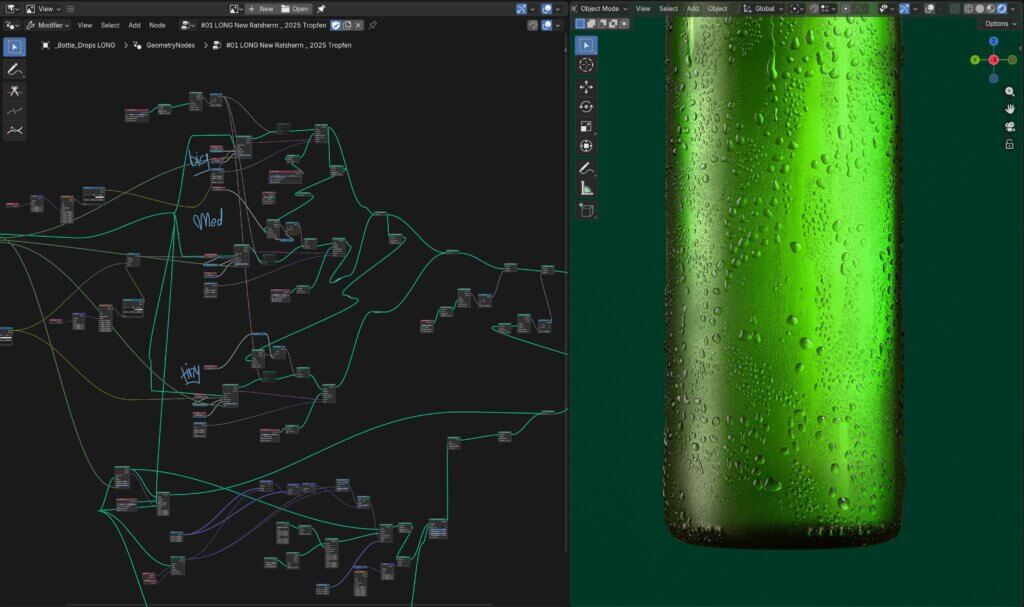
Then there are the running drops — those thin streams that trace downward paths on a cold bottle. We painted those directly onto the geometry using Geometry Nodes, creating trails that follow the curvature of the glass and interact with the droplet field around them. The result: thousands of individual water elements per bottle, all behaving according to a set of rules derived from observation, not guesswork.

The $2.85 billion shift: why beverage brands are moving to 3D
This is not a niche experiment. According to HTF Market Insights, the global 3D product visualisation market reached USD 2.85 billion in 2024 and is projected to grow at 18.7% annually, reaching over USD 12 billion by 2033. Beverage brands are a significant driver of that growth — and for good reason.
Consider the practical reality of a traditional beer photo shoot. You need physical bottles of every variety, a temperature-controlled studio, a photographer, assistants to constantly re-spray condensation (because real condensation evaporates in minutes under studio lights), and a retoucher to clean up the inevitable inconsistencies. Multiply that by a product line of four, six, or twelve varieties. Now do it again for every seasonal campaign, every market, every format.
With a procedural 3D system, you build the bottle once, apply any label, adjust the glass colour, and generate perfect condensation on demand. Need a new variety? Swap the label, tweak the glass shader, render. Need the same shot but for a different campaign? Change the lighting, the angle, the background. The condensation regenerates itself, physically correct every time. Coca-Cola has already partnered with NVIDIA to develop scalable CGI pipelines for their global campaigns across more than 100 markets. The industry is moving — the question is whether your brand is keeping up.
What makes this a breakthrough — not just another render
Let me be direct about this: in beverage visualisation, photography has always won. Every serious creative director knew that when it came to hero shots of cold drinks, a skilled photographer would outperform even the best 3D artist. The glass looked more real, the condensation felt more alive, the light played more naturally across wet surfaces. That gap is what kept many brands from fully committing to 3D product visualisation.

This project closes that gap. When we showed the finished renders, the reaction was immediate — people could not tell they were looking at CGI. Not because we used tricks or post-processing to hide flaws, but because we built the condensation from first principles. The proximity-based droplet distribution, the running lines, the scale variation, the way light refracts differently through each droplet depending on the glass colour beneath — all of it follows the same rules that govern real physics. The result does not just look photorealistic. It looks like a photograph taken by someone who had infinite patience and a bottle that never warmed up.
“It looks like a photograph taken by someone who had infinite patience and a bottle that never warmed up.”
Scalable, adaptable, and built for product lines
The system we developed is not locked to a single bottle shape or brand. The node setup can be applied to different bottle geometries and adapted through parameter adjustments — droplet density, size distribution, stream behaviour, condensation intensity. For a brand with an expanding product line, this means consistency across every variety without re-shooting, and the flexibility to produce new visuals whenever the market demands them.
We invested weeks of development into this system, going beyond the original project scope because we knew the result had to be flawless. That kind of commitment is what separates a render that looks “pretty good” from one that makes a creative director do a double take. For breweries, beverage companies, and their agencies, this represents a new standard: CGI product imagery that does not ask you to compromise between photorealism and the flexibility of 3D.
Let’s talk about your product
If you are a brewery, beverage brand, or agency looking for product visuals that match the quality of traditional photography — with the speed, consistency, and scalability of 3D — let’s have a conversation. Whether you need hero shots for a campaign, 360° product animations, or a full visual system for an entire product line, we have the tools and the craft to make it happen.
Lauktien Studio creates photorealistic 3D product visualisations, animations, and creative retouching for brands and agencies worldwide.

Rüdiger Lauktien
Married to his wonderful wife, father of two. Drummer, dreamer, pipe-smoker, photographer, adventurer and a man of faith. More than 15 years of experience in the creative industry. Awarded Digital Artist and Art Director.