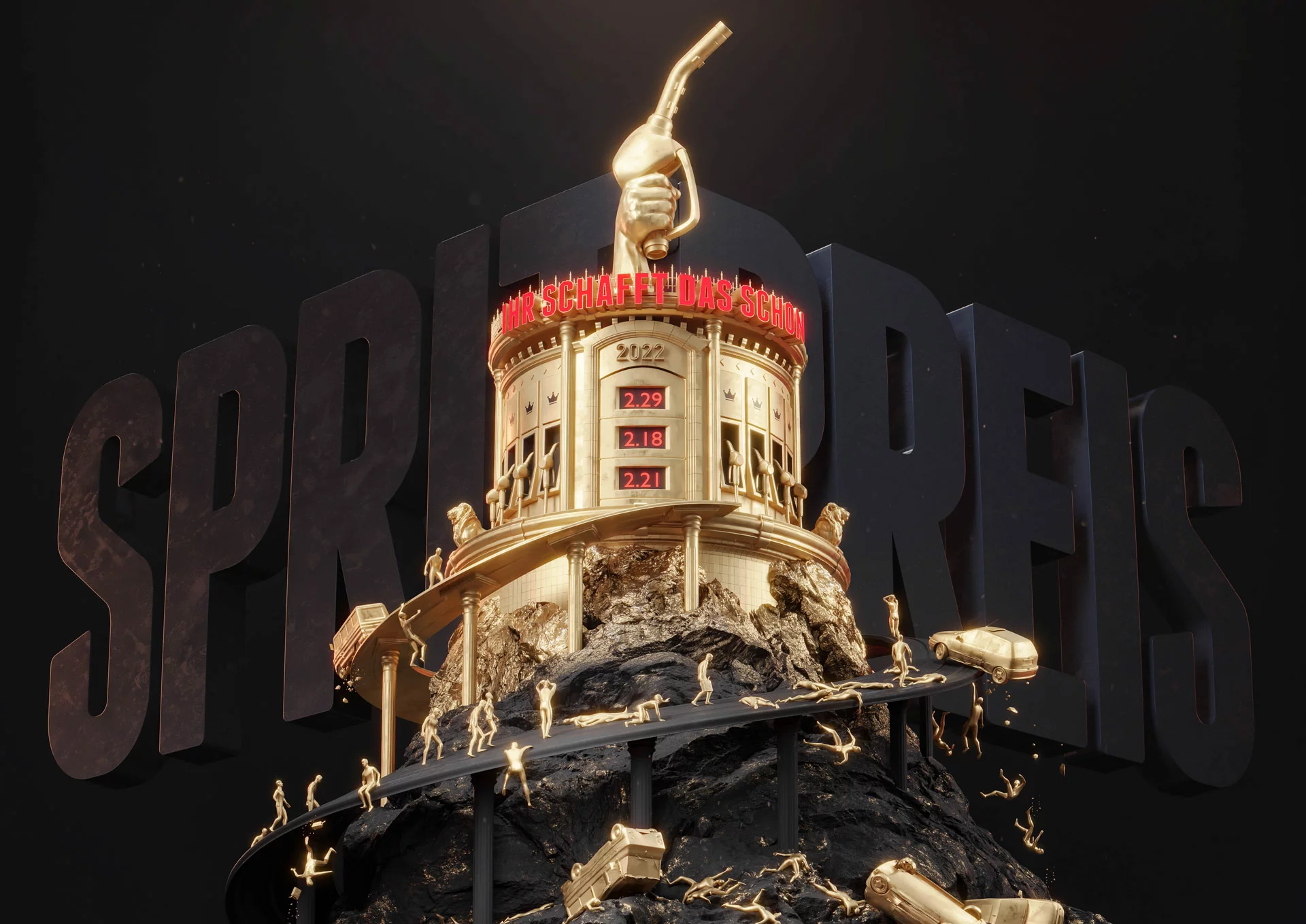
This fuel price CGI artwork started as a personal response to a crisis everyone felt. When the war in Ukraine triggered record fuel prices across Germany in 2022, the numbers were abstract — but the impact wasn’t. We translated that impact into a single photorealistic scene: a steep mountain road, cars tumbling, figures stumbling or already fallen. The piece was recognised by Lürzer’s Archive as an award-winning work — one of the most competitive digital art selections in the industry.
The fuel price CGI artwork — how it was built
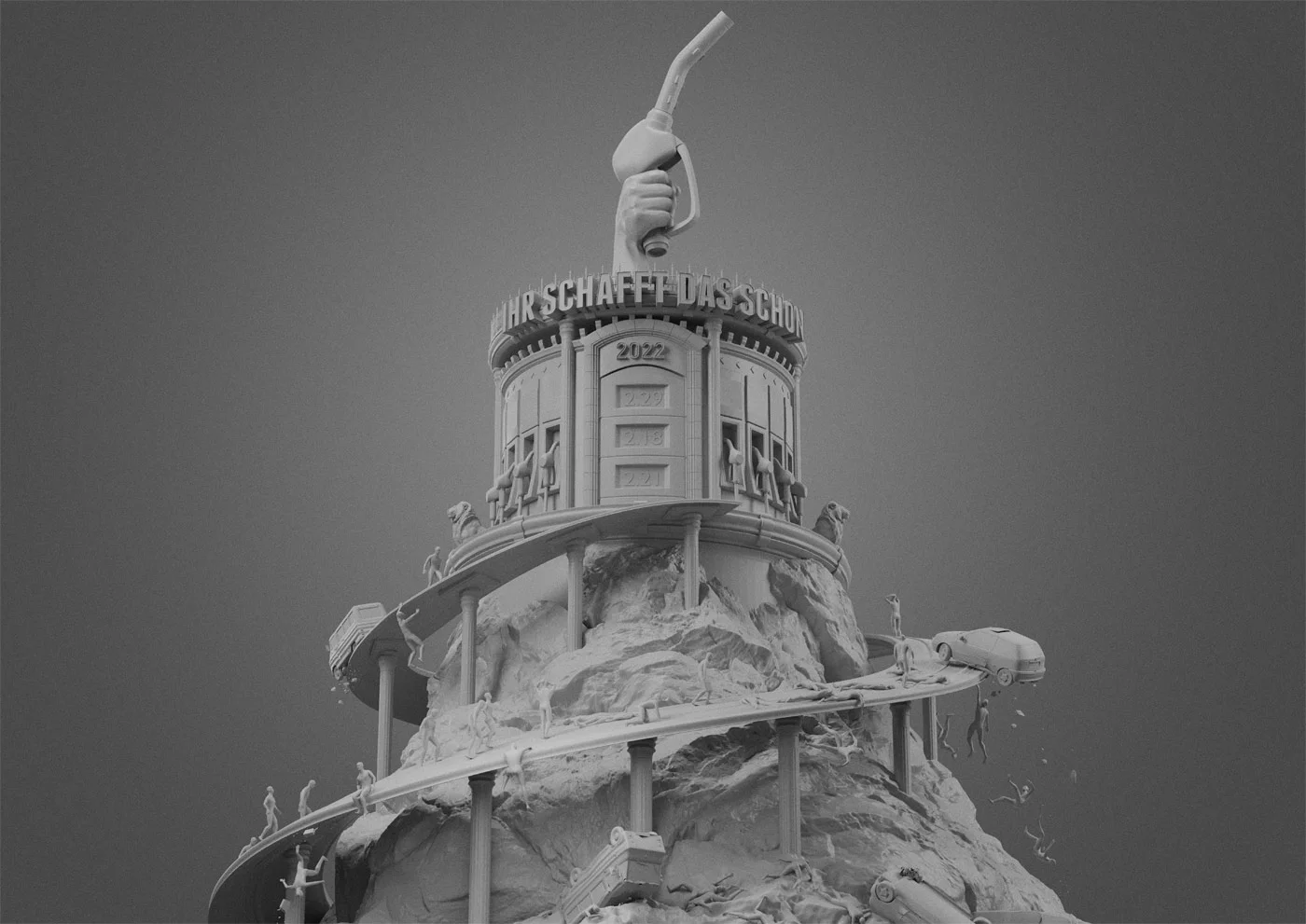
The scene was constructed entirely in 3D — every figure, vehicle, and road surface modelled and rendered to photorealistic precision. The making-of frames show the clay model stage and the full progression from raw geometry to final composite. We built the social tension directly into the geometry: the incline angle, the scale of figures against the road, the density of people higher up versus those already collapsed at the base. Nothing is accidental.
Why CGI artwork lands harder than illustration
A drawn illustration signals effort — but it also signals distance. Photorealistic CGI closes that gap. Because the scene looks like it could exist, the emotional response is immediate. Viewers react before they analyse. That’s exactly what makes this format effective for social criticism, editorial work, or campaign key visuals where the message must land before the brain engages. Furthermore, CGI gives complete control: no real locations, no logistics, no weather. If you’re considering this approach, our piece on why CGI beats a photo shoot covers the production case in detail.
More conceptual CGI artwork and key visuals
See also Energy Transition | CGI Key Visual and Bedtime Stories | CGI Artwork for more conceptual work in the same vein. If the concept is strong, the render will carry it. Your idea. Our render. Let’s talk.