Why AI packaging design commercial use needs an honest framework
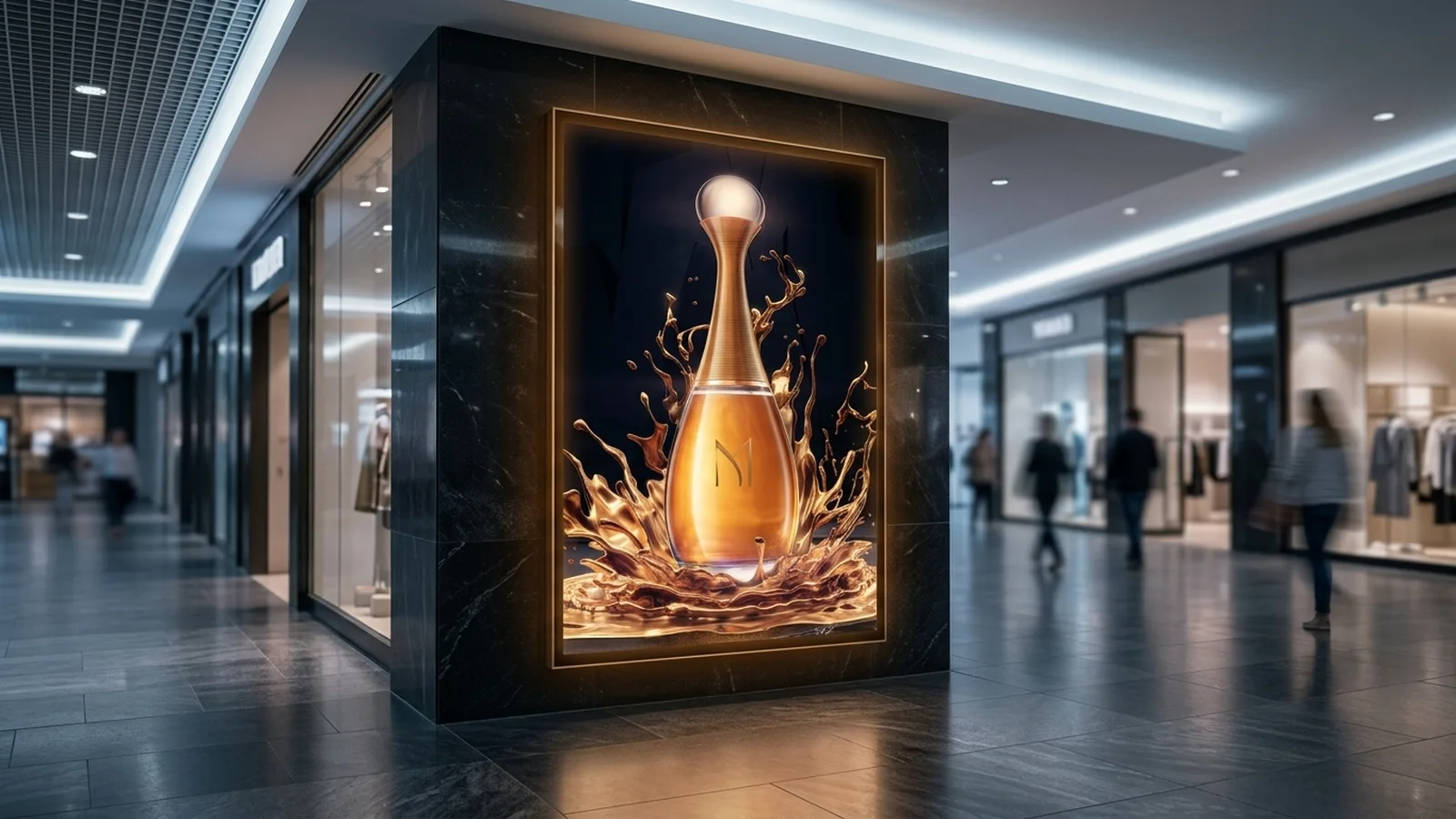
Picture a scenario we walk through with brand teams almost every week. A creative director sits in front of a Midjourney board: twelve perfume bottle variations, all stunning thumbnails, all completely unusable for production. The bottle silhouette drifts between frames. Cap geometry is different in every shot. Worse, the wordmark is hallucinated lettering that almost — but not quite — reads like the brand. And the unspoken question on top of the deck is always the same: “can we just ship these as the campaign hero?”
No. And in 2026, that answer matters more than ever, because the question is no longer hypothetical. Above all, AI packaging design commercial use has moved from experiment to line item on most brand budgets. Moreover, the market data confirms it. According to Fortune Business Insights, the generative AI in packaging market is projected to grow from roughly USD 27 billion in 2026 to over USD 164 billion by 2034, a 25 percent compound annual growth rate. Furthermore, McKinsey describes generative AI as the packaging industry’s next frontier. In practice, the tools are here, the brands are spending, and the agencies are pitching with AI-rendered boards.
However, we keep meeting brand teams who confuse fast and useful with production-ready. The two are not the same. This article is the framework we wish every art director, brand manager, and agency producer had before commissioning their next packaging campaign. Where AI genuinely helps. Where it quietly destroys brand consistency. And how a serious studio uses both — without lying to anyone about which is which.
Where AI packaging design commercial use genuinely shines
To begin with, let us be unambiguous. Generative AI is the best ideation tool the packaging design world has seen since mood boards arrived in the studio. Consequently, in four specific stages of the workflow, it is now indispensable.
First of all, early-stage exploration. A brand manager has a vague new direction — “warmer, more nostalgic, less clinical” — and twenty competing references on Pinterest. In the past, a packaging designer would spend two days converting that gut feeling into three rough mood directions. Today, the same designer generates forty AI variants in an hour, throws thirty-five away, and walks into the next brand meeting with five concrete starting points instead of one tentative one. The conversation moves from “do you like this kind of thing?” to “which of these five directions do we lock?” That is a meaningful productivity gain.
Secondly, colour and finish exploration. AI is excellent at showing a bottle in fifty different finishes — frosted glass, matte ceramic, hammered metal, warm transparent amber — without anyone touching a CAD file. As a result, the brand can pre-eliminate eighty percent of finish options before the CGI team or the manufacturer is briefed. Furthermore, the team avoids the costly trap of asking a 3D studio to model six versions and then choosing one. We did that for clients a decade ago. We do not miss it.
Thirdly, contextual mood imagery. AI is genuinely strong at producing the atmosphere around the product — the marble countertop, the sunlit hotel bathroom, the dimly lit speakeasy bar. In contrast, photographing those environments traditionally requires location scouting, permits, and a full crew. For non-hero supporting visuals — social tiles, paid social variants, blog headers, internal sales decks — AI delivers usable assets at a fraction of the previous cost. Consequently, brand budgets shift toward the few moments that still demand craft.
Above all, internal alignment. The packaging design committee — marketing, brand, legal, retail, the agency, the CEO — can finally look at the same image at the same time. No more “imagine the cap is metallic.” The visual is right there. Moreover, it costs nothing to regenerate when the chairman wants a different cap colour at 9pm.
Ultimately, that is real value. As a result, our commercial AI key visual service exists for exactly these stages — fast, brand-aware AI exploration that an art director can actually approve and send forward.
Where AI packaging design commercial use quietly breaks
And then comes the part most agency pitch decks skip. However, AI is not a packaging production tool. Not yet, and not for any brand that takes its identity seriously. In contrast to the ideation phase, there are five hard failure modes we see every week, and brands need to recognise them before they get burned on a major campaign.
The first is typography. AI tools cannot reliably render brand wordmarks, batch codes, ingredient lists, or any printed text. The output looks correct at thumbnail size and becomes hallucinated nonsense at hero scale. For a luxury beauty brand whose entire equity is in a specific serif rendering of its name, that is a campaign-ending problem. Consequently, every piece of AI output destined for production has to have its typography stripped and replaced manually — at which point you are already in a compositing or 3D workflow.
The second is consistency across variants. A campaign needs the same bottle in six languages, twelve sizes, four light setups, and three angles. AI gives you twenty similar but different bottles. The cap is rounder in one shot. A label sits 2mm lower in another. Glass tint shifts between sunlit and indoor. Customers notice. Retail buyers notice. Your design director’s eye twitches when she scrolls the campaign deck. As a result, AI alone cannot deliver a coherent product family — only the controlled geometry of a CGI model can.
The third is physical accuracy. Material behaviour, light refraction through coloured glass, condensation, the exact way an embossed foil catches a spotlight — these are physics, not vibes. Meanwhile, CGI uses real material parameters and a virtual camera that obeys real optics. In contrast, AI approximates the look. As a result, the difference is invisible on Instagram and very visible on a 4×6 metre OOH poster.
The fourth is dieline and production hand-off. Packaging is, in the end, manufactured. The factory needs a flat dieline showing exactly where to cut, fold, glue, emboss, and where every printed element sits — front label, ingredient list, batch code, barcode, recycling marks, regulatory icons. AI generates pretty pictures, not production files. Industry analysts at Packaging School made the same point in their 2025 review of AI packaging tools: the dieline still requires proper packaging design software or a trained packaging designer. Until that gap closes — and there is no near-term sign that it will — AI lives upstream of production, not inside it.
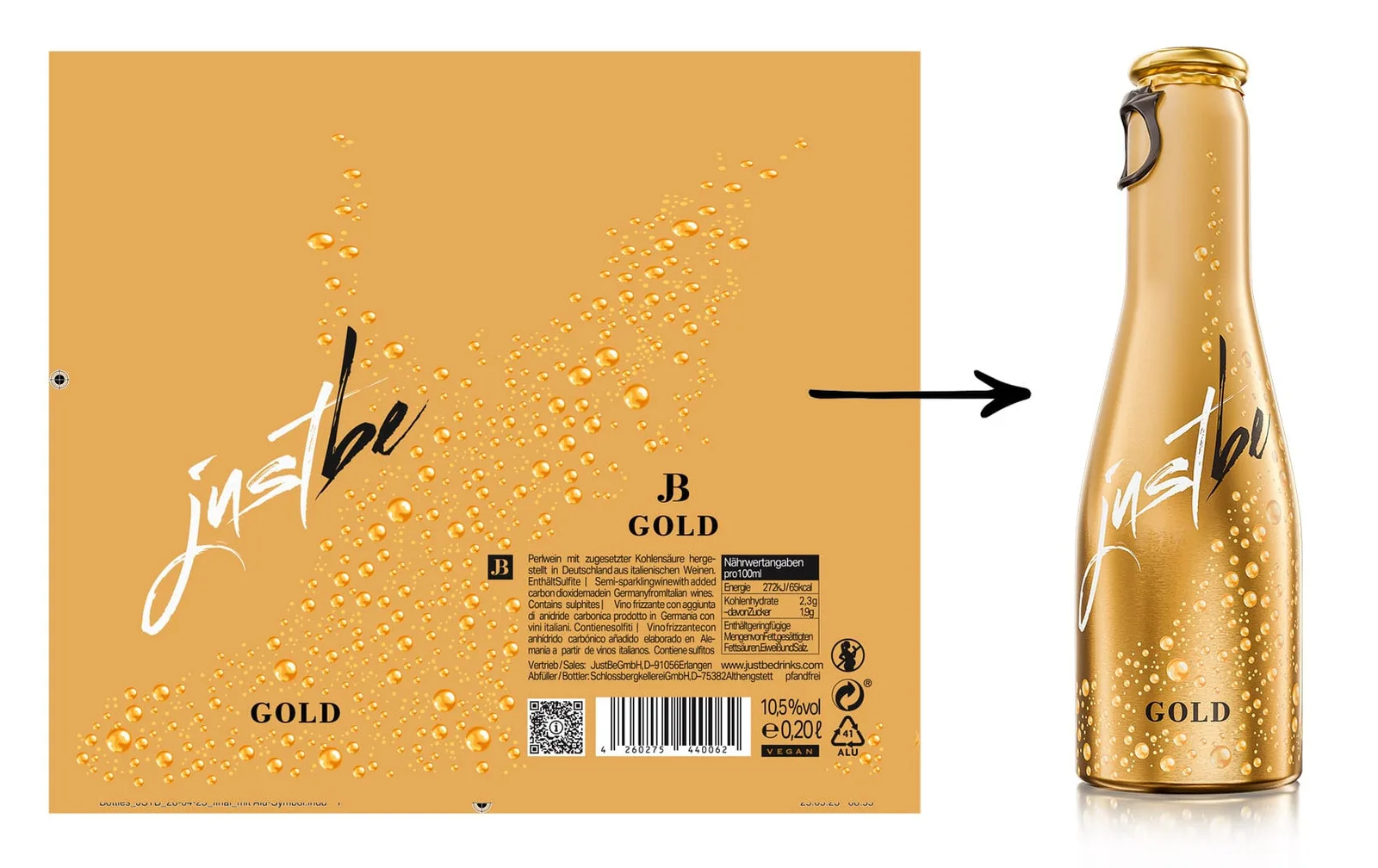
The justbe Gold example above makes the point in a single frame. On the left, the flat 2D print artwork that goes to the factory — including the ingredient declaration, the nutrition table, the barcode, the EU recycling and ALU marks, and the wordmark positioned to the millimetre. On the right, the finished bottle visual the brand actually publishes. Bridging the two requires a controlled production geometry where every element of that print file lands in exactly the right place on a curved aluminium surface. Furthermore, the bottle has to read correctly under campaign lighting, at every angle, in every retail size. That is CGI territory, not generative AI territory.
The fifth is legal defensibility. We covered this in detail in our piece on the legal risks of AI generated marketing images, but the short version is: training-data provenance and EU AI Act disclosure obligations make pure-AI hero packaging visuals harder to defend in a dispute than a CGI render where every model, material and pixel has a documented source.
The hybrid workflow we actually run for clients
In practice, the brands who are getting AI packaging design commercial use right are not picking sides. They are stitching AI and CGI into a single, deliberate pipeline. Here is the version we run for our own clients in cosmetics and beverage.
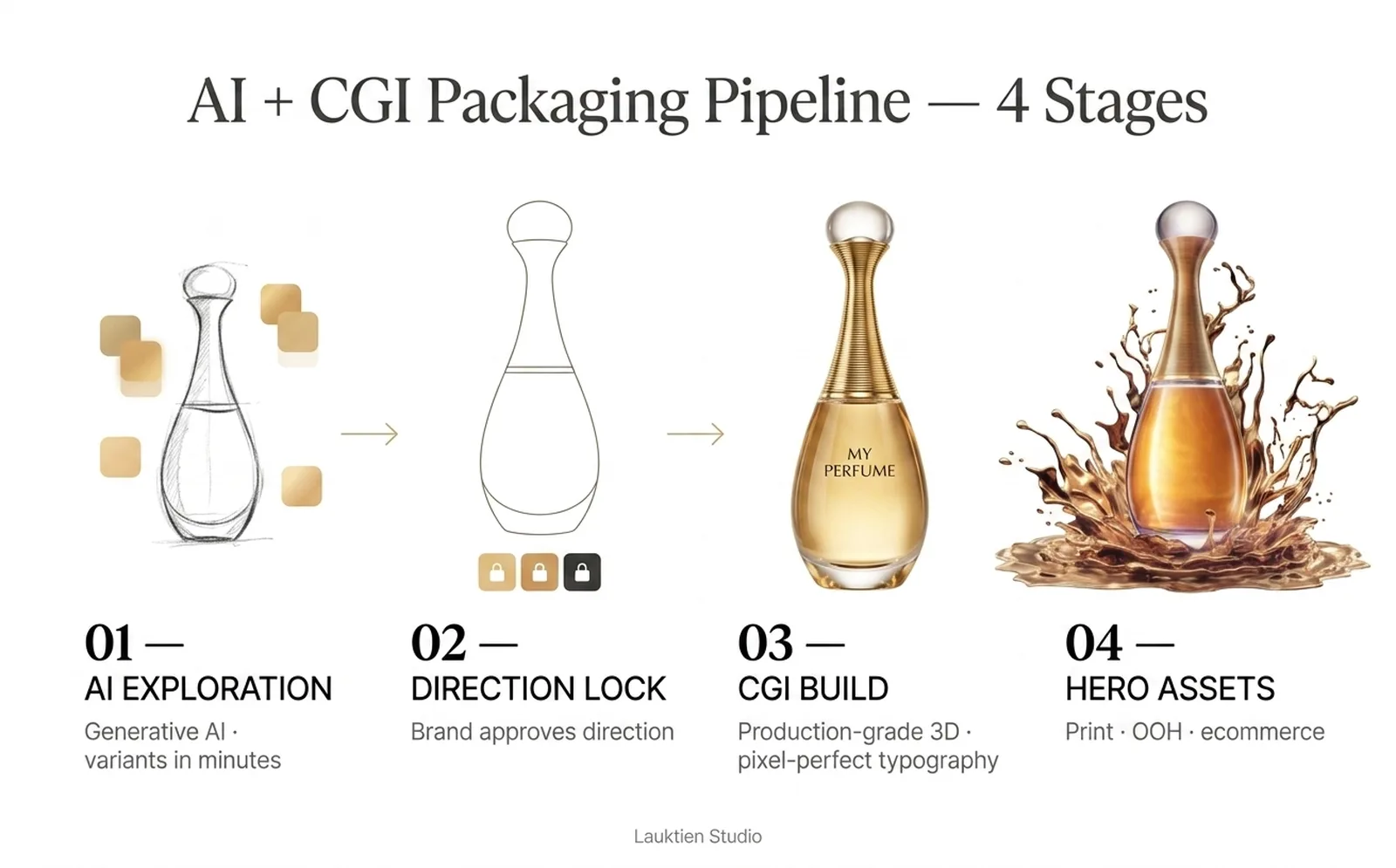
Stage 1 — AI exploration. First of all, the brand sends us a verbal brief and existing reference. Consequently, we generate thirty to sixty AI variants across three or four directions, curate down to five, and present a single board to the brand stakeholders. Turnaround: typically two days. Cost: a fraction of a traditional sketch phase.
Stage 2 — direction lock. The brand picks one direction. We agree the silhouette, the dominant material, the colour palette, and the typography treatment in writing. This is the moment the AI exploration ends and the production discipline begins. No more variant chasing. Furthermore, every later decision references this lock document.
Stage 3 — CGI build. Our 3D team models the bottle, the cap, the labels, the secondary packaging. Every surface uses physically accurate materials. The wordmark is placed using the brand’s actual font file, at the actual size, at the actual position. The lighting is rebuilt to match the AI direction but obeys real optics. Meanwhile, the brand can request as many variants — colour, language, size, angle — as the campaign demands, because the underlying geometry is a single source of truth. Our 3D product visualization service is built specifically for this stage.
Stage 4 — hero assets. Finally, we deliver the final renders for print, out-of-home, ecommerce, and social. Moreover, the same CGI model also produces 360 spin assets for the brand’s product page and the retail partners’ product detail pages. One asset library. Every channel. Consistent across all of them.
As one experienced design lead might put it in plain language:
“AI got us to the right answer faster. CGI made sure the answer was actually printable.”
A way to think about the hybrid pipeline
That sentence is the entire 2026 hybrid pipeline in two clauses.
What to brief, what to skip
If you are a brand manager or producer commissioning AI packaging work in the next quarter, here is the short version of the brief we wish landed in our inbox every time.
First of all, state the campaign deliverables and channels up front. A brand needing only Instagram tiles has a different AI budget than a brand needing OOH plus retail standees plus an ecommerce hero. Furthermore, be honest about which assets are throwaway and which are brand-defining. The first category is AI territory. In contrast, the second is hybrid territory.
Secondly, provide the brand font files, wordmark vector and Pantone references. Without those, the studio cannot replace AI-hallucinated typography with the real thing, and consequently you will end up with another generic “AI looks” campaign you cannot file as a trademark proof of use.
Decide who owns the dieline. Is the packaging supplier delivering the structural file, or is your design agency producing it? AI does not produce dielines. Someone has to. Furthermore, if the answer is unclear, the project will stall at the production-handover stage and lose three weeks. We have seen it five times in the last year alone.
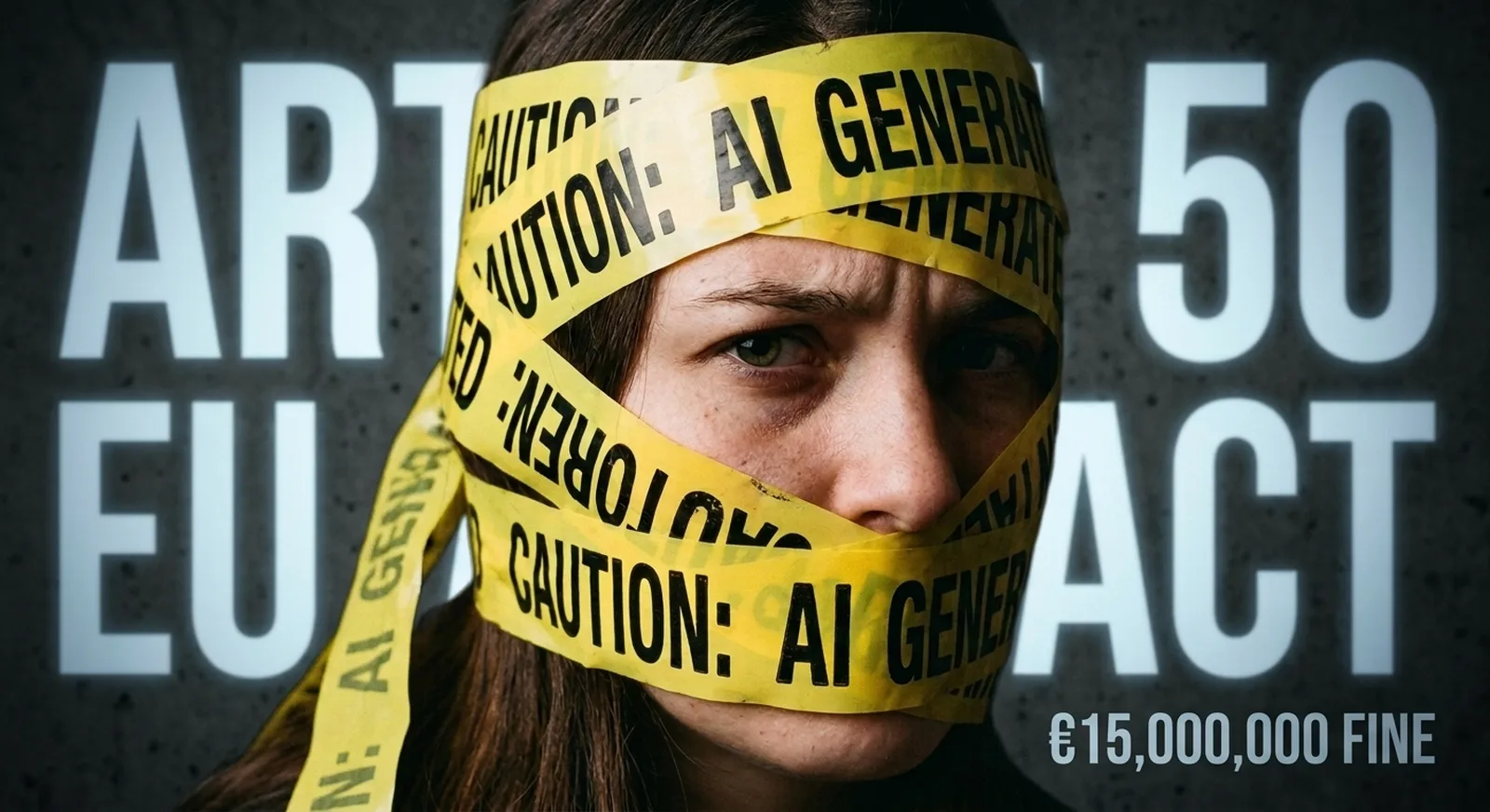
Moreover, be explicit about disclosure obligations. The EU AI Act and several major retailers now require disclosure when synthetic imagery is used in marketing. In practice, pick your position before the assets ship, not after. As a result, we covered the full framework in our AI marketing image legal risks article — read it before the next campaign goes live.
Finally, decide your fallback for the hero shot. If the campaign goes big, where does the hero asset come from? In our experience, the brands who pre-commit to a CGI hero — even if they explore the direction with AI — sleep better when the brief expands at week six. In contrast, the alternative is rebuilding the hero from scratch under deadline, and nobody wants that. Above all, for the full briefing structure we recommend, see our piece on how to brief a CGI studio.
Where AI packaging design commercial use is heading next
Two trends will shape the next eighteen months. The first is brand-tuned AI models. Large brands are training internal LoRAs and reference models on their own packaging library, which solves part of the consistency problem and shifts the work from generic prompting to controlled generation. Meanwhile, the legal and IP teams are quietly building the contracts that surround those models. Expect a wave of brand-locked AI tools entering the agency conversation in 2026.
The second is AI-to-3D conversion. New tools claim to convert a 2D AI render into a textured 3D mesh. In our hands, the output is good enough for early visualisation and not good enough for hero advertising or manufacturing. That gap will narrow. However, it will not close fast enough to replace a proper CGI pipeline in 2026 or 2027 for any brand that cares about brand surface fidelity. In the meantime, the hybrid workflow is the answer that ships campaigns on time.
Ultimately, AI packaging design commercial use is the right phrase, but the word that matters in it is commercial. Commercial assets have to be defensible, manufacturable, brand-consistent, and shippable at any size. AI gets you to a great direction faster than anything else in our toolkit. CGI gets you across the finish line.
In other words, if you have a packaging campaign on the calendar this year and you are unsure which moments deserve AI and which deserve CGI, that conversation is exactly what we are here for. Reach out whenever you are ready — we will tell you straight which parts of your brief AI can handle today, and where the hybrid workflow will save your hero shot.
Lauktien Studio is an independent CGI and key visual studio in Berlin. We build photoreal product visuals, AI-assisted concept work and end-to-end campaign assets for brands and agencies in cosmetics, beverage, automotive and technology.

Rüdiger Lauktien
Married to his wonderful wife, father of two. Drummer, dreamer, pipe-smoker, photographer, adventurer and a man of faith. More than 15 years of experience in the creative industry. Awarded Digital Artist and Art Director.