360° product animation: the view your customers are already looking for
Why one rotation does more than six static shots ever could
Your product page looks good. The images are sharp, the lighting is clean, the composition is solid. And somewhere right now, a potential customer is hovering over the buy button — squinting at your hero shot, trying to mentally rotate the product in their head, and deciding not to click.
Not because they don’t like it. Because they can’t quite see it.
That split-second of uncertainty — that moment where curiosity becomes doubt — is exactly what a 360° product animation is designed to eliminate. And if you’ve never seen one done right, it’s worth understanding what it actually is. And what it isn’t.
Not a spin widget. A cinematic rotation.
A lot of people hear “360° product view” and think of those clunky e-commerce spin tools where you drag the mouse and a blurry photo sequence staggers around the screen. That’s not what we’re talking about.
A proper 360° product animation is a smooth, fully rendered CGI rotation — every frame lit consistently, every surface behaving correctly. Chrome reflects the way chrome should. Matte textures don’t blow out. The logo reads clearly at 45 degrees. The back panel and base and details you’re actually proud of — all visible, all correct, all compelling. The camera moves. The product doesn’t. And the whole thing feels effortless.
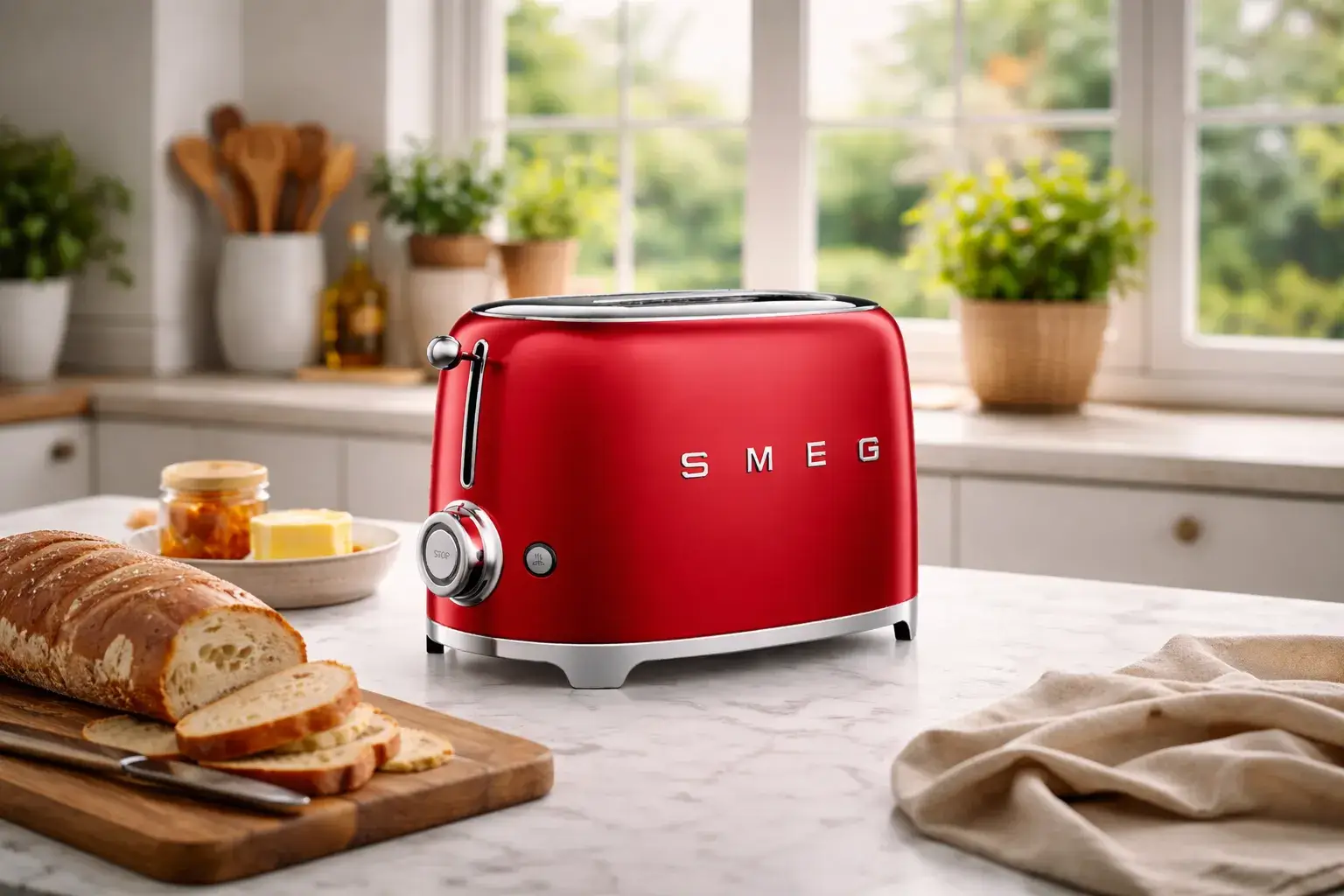
We built this for a Smeg Toaster. Their classic two-slot toaster in that unmistakable red. The target was simple: show the product from every angle, with consistent light, without a multi-day studio shoot. – Seven seconds. Every surface. Done. One master file that can be cut into a reel, embedded on a product page, or dropped into a sales deck — without a single re-shoot.
When the packaging is the product
Hardware is one thing. But some products live or die entirely by how their packaging reads — and here, 360° CGI has an even stronger argument to make.
The Just Be bottles by Davina Gates are a good example. Three variants, complex gradient packaging, a semi-transparent label with bubbles and shimmer effects, fine typography that changes as the bottle rotates. You can’t capture that in two or three hero shots. You’d spend a day in the studio, end up with images that show the front beautifully — and leave the rest to the imagination.
“You’d spend a day in the studio, end up with images that show the front beautifully”
The 360° rotation solves this in one asset. Front-facing for the launch campaign, back label for the legal info, mid-rotation for the gradient detail — one animation, all angles, full story. The brand gets to show off the packaging they actually designed, not just the face of it.
The numbers are not subtle
If you need a business case, here it is. According to Wyzowl’s 2025 video marketing report, websites that include video achieve an average conversion rate of 4.8% — compared to just 2.9% for those without. The conclusion is uncomfortable for brands still relying on static imagery alone. According to Practical Ecommerce, True Value saw conversion rates rise by 22 percent after adding 360 degree product animations views to their product pages. The Home Depot tested 360° product photography against standard images and saw a 35 percent reduction in returns. A 2018 Grainger case study reported a 9.6 percent sales increase from 360° product presentations alone.
The logic is obvious once you see it. When customers know exactly what they’re buying — every surface, every angle, no surprises — the uncertainty disappears. And uncertainty is what causes abandoned carts and return requests. Not price. Not shipping time. Doubt about the product itself.
“True Value saw conversion rates rise by 22 percent after adding 360° views to their product pages”
For premium products especially, this matters. If someone is spending €300 on a designer kitchen appliance or €80 on a premium beverage gift set, they want to feel like they know what they’re getting. A six-second rotation gives them that. A static front-facing hero shot doesn’t.
One asset, every format
Here’s where CGI has a structural advantage over photography that doesn’t get talked about enough: one render session produces assets for every channel simultaneously.
The same 360 degree product animation becomes your Instagram reel, your website hero loop, a frame in your press kit, a clip in your sales deck, and a cover image for your product catalogue. Different formats, different crops — all from the same consistent source. No re-shoots for different platforms. No “can we get that angle again for the banner ad”. The CGI model exists permanently — any new angle, any new variant, any new background is a render job, not a studio booking.
For agencies managing multiple product launches in a season, the efficiency is significant. One project brief, one model, six months of usable assets. That’s a different way of thinking about product visual production — and once you’ve worked that way, going back to single-use photography feels unnecessarily expensive.
Let’s talk about your product
If your product pages are stacking static shots and conversion feels flat — or you’re managing a product launch and already know you’ll need assets for six different channels — the 360° animation might be the most useful thing you add to this year’s brief.
Take a look at what we do with 360° product rendering for brands and agencies, and let’s work out what your product actually needs.
Lauktien Studio produces CGI product animations, 360° renderings, and creative retouching for brands and agencies. Based in Berlin.

Rüdiger Lauktien
Married to his wonderful wife, father of two. Drummer, dreamer, pipe-smoker, photographer, adventurer and a man of faith. More than 15 years of experience in the creative industry. Awarded Digital Artist and Art Director.