What 3D product visualization cost actually pays for
The procurement call always reaches the same awkward minute. Everybody likes the brief. The timeline is doable. References are agreed. Then somebody clears their throat and asks the question nobody wants to ask first. So, roughly, what’s the 3D product visualization cost on something like this? Most studios deflect. Honestly, we’d rather just answer.
This guide is the answer we’d give you on that call, written down. It walks through realistic 2026 ranges for product CGI. It covers what actually moves the number on the invoice. And it shows how to brief a project so the budget lands where you need it. For the broader strategic view first, our 3D product visualization service page covers the wider scope of what a studio like ours delivers.
Why 3D product visualization cost varies so wildly
Ask five studios for a quote on the “same” project, and you may get numbers from €400 to €40,000. That spread is the central problem. CGI is not a commodity. Above all, the price reflects what the renderer cannot see. It pays for the modeling labour, the material research, the lighting setup. It pays for the iteration loops with the brand team. Most of all, it pays for the experience of the artist who decides which of the seventeen possible looks is the one your customer will trust.
CGI is not a commodity. The price reflects what the renderer cannot see — the modeling, the materials, the iterations, the artist’s eye on the seventeenth lookdev pass.
Furthermore, the same product can be rendered in a few hours for a marketplace listing. It can also take three weeks for a global luxury campaign. Both are legitimate uses of CGI. As a result, both are legitimate prices. They simply buy very different things. Understanding the spectrum protects your budget from disappointment in either direction.
Four pricing models for 3D product visualization cost
Most studios price in one of four ways. The model alone tells you a lot about the working relationship. First, per image. You pay a fixed amount per delivered angle or variant. It is predictable, easy to compare, and ideal for catalogue work or listing shots.
Secondly, per project. The studio scopes the whole engagement — modeling, look development, the final outputs you need — and gives you one number. This works better for campaigns where the lines between hero, social, and OOH blur during the work. In contrast, hourly billing fits true open scopes. Think research, R&D for a new material, or projects where the brand team doesn’t yet know what they want. Finally, retainers cover brands with rolling needs. Typically that means a fixed monthly budget converted into a flexible amount of CGI work each month.
Different industries gravitate to different models. For instance, marketplaces and eCommerce tend to favour per image. Meanwhile, beauty, beverage, and automotive launches almost always sit on per-project. In other words, the pricing model is rarely arbitrary. It follows the shape of the work.
Honest 2026 ranges for 3D product visualization cost
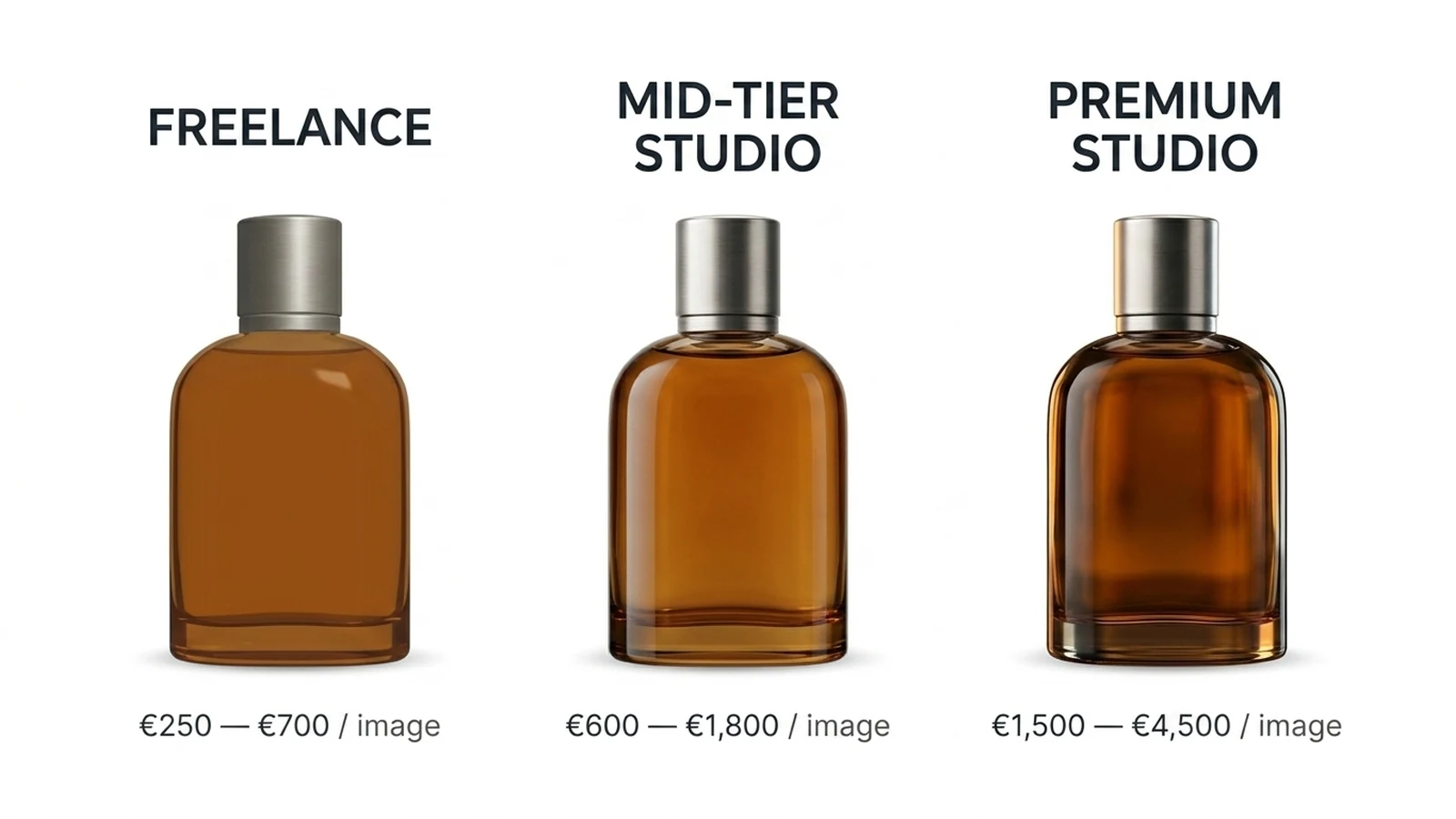
Below is what we see in the European and North American market in 2026. The numbers come from our own quotes and from industry surveys. These are honest brackets. They are not the lowest figure a freelancer in a low-cost market might charge for a single render of a matte white box.
Still product images. A simple e-commerce hero on a white background usually lands between €250 and €700 per image at a freelancer. The same brief sits between €600 and €1,800 per image at an experienced studio. Premium beauty, beverage, or automotive renders cost more. Those carry reflective glass, accurate liquids, branded labels and full retouching. They commonly sit between €1,500 and €4,500 per hero image. According to industry pricing surveys aggregated across studios, agencies typically charge 40 to 100 percent more than freelancers for the same brief. That sounds steep until you have lived through your first deadline-day re-render.
360° spins. An interactive 360° product spin for an online shop generally costs between €1,000 and €3,000. The exact number depends on frame count, surface complexity and how clean the loop has to be. Considering a spin for a Shopify or Amazon listing? Our 360° product rendering service page goes into the integration side of that decision in detail.
Animation. A short 5- to 10-second product animation for social currently runs between €2,500 and €6,000 for something polished but compact. Marketing-grade hero films cost more. They include multiple shots, full sound design, high-end lighting and choreographed camera moves. Those typically sit between €8,000 and €25,000. Luxury campaign films climb well past that. As a rule of thumb, every additional second of finished animation adds engineering work. The cost compounds rather than scales linearly.
What actually changes the 3D product visualization cost on your invoice
For a useful predictor, ignore the headline question of “cheap or expensive”. Look instead at the variables that actually move the number. The biggest one is geometry. Hard-surface products like a smartphone or speaker are far less expensive to model. Soft-deformable objects cost more — think a cosmetic tube being squeezed, or a beverage with a custom-shaped glass. We covered this same trap in our CGI versus product photography breakdown. In short, geometry beats genre when predicting CGI complexity.
The second variable is materials. Matte plastic and brushed aluminium are well-understood. By contrast, anything translucent, refractive, or wet adds cost. Perfume, whisky, ice, condensation, transparent gel — these add light-transport calculations. Such calculations quietly multiply rendering time and lookdev iterations. Meanwhile, the third variable is variant count. One product in one colourway is one model. The same product in twelve flavours, with localised labels and three pack-sizes, is a system. Building that system upfront costs more. However, every subsequent render becomes near-free. That is exactly why scaling brands have moved this way for years.
Geometry beats genre when predicting CGI complexity. A reflective perfume bottle is harder than a luxury logo. A wet condensation shot is harder than a hero car.
Finally, expectations. A render that has to look “real enough for Amazon” is not the same job as one that has to survive a billboard at four metres. Consequently, the level of precision in modelling, lighting, and compositing has to scale. It must match whichever of those uses your campaign actually demands.
Where CGI quietly pays for itself
The case for 3D product visualization cost rarely lives in the per-image comparison. It lives in the variants, the second campaign, and the missing prototype. According to Shopify’s own changelog data, merchants who add 3D content to their stores see an average 94% conversion lift. That number is large enough for even small e-commerce catalogues to recover the investment quickly. Moreover, IKEA has been public for over a decade about its catalogue. Around three quarters of its catalogue imagery is CGI, not photography. They didn’t switch because it’s flashy. They switched because shipping prototypes around the world became more expensive than rebuilding them in software.
For brands working with us, the same logic plays out at smaller scale. The first hero render is rarely cheaper than a comparable studio shoot. However, the second wave is. Think the third colour variant, the German pack-size, the Black Friday holiday sleeve, the spec-sheet macro the photographer never captured. Those start to arrive in days, not weeks. They cost a fraction of the original setup. You can see how this plays out in our smartphone case product visualization project. The original 3D model produced an entire family of variant renders without re-shooting anything.
The first hero render is rarely cheaper than a comparable studio shoot. The second wave always is.
Where CGI is the wrong call
For all that, CGI is not always the right answer. Pretending otherwise wastes everyone’s time. Single-angle photography of an existing product in the warehouse is often cheaper to shoot than to build in 3D. Highly editorial campaigns with real models and real fabric tend to read better when the human element is photographed. In practice, hybrid workflows are increasingly common. Those combine a photographed model, a CGI product, and a clean composite. Above all, they are where our creative retouching service earns its keep. Is your project conceptual, fast, and only meant to live online for a week? Then an AI-assisted route via our commercial AI key visual service may be the more honest recommendation.

How to brief us so the budget lands where you need it
Most quotes go wide because most briefs go vague. To get a sharp number, give the studio four things upfront. First, the final use — web tile, OOH, packaging, broadcast. Second, the number of angles or variants you actually need. Then your reference set, showing the visual ceiling. Finally, your real deadline. We wrote a longer guide on this. See how to brief a CGI studio and actually get what you need. Indeed, it pays for itself the first time you use it.
One last note on the 3D product visualization cost conversation. Cheap is not a category. Fast is not a category either. The categories that matter are different. Specifically: how long does this image have to last? Then, how many people will see it? Above all, how much trust does it need to carry in the moment they see it? Once those three are settled, the price stops being mysterious.
Let’s talk about your project
Have a brief in front of you and want a real number rather than a range? Send it over. Ultimately, the easiest way to learn the 3D product visualization cost of your specific job is to get a quote. We’ll come back with a scoped proposal, not a marketing PDF. In the meantime, the 3D product visualization service overview shows what we routinely deliver. It also shows at what fidelity.
Lauktien Studio is a Berlin-based CGI and 3D visualization studio. We work with international brands and agencies on product imagery, key visuals, 360° spins, and creative retouching. For over a decade, we’ve helped marketing teams plan budgets that survive the briefing — and the second round of feedback.

Rüdiger Lauktien
Married to his wonderful wife, father of two. Drummer, dreamer, pipe-smoker, photographer, adventurer and a man of faith. More than 15 years of experience in the creative industry. Awarded Digital Artist and Art Director.