AI vs manual retouching — what actually changed since 2022
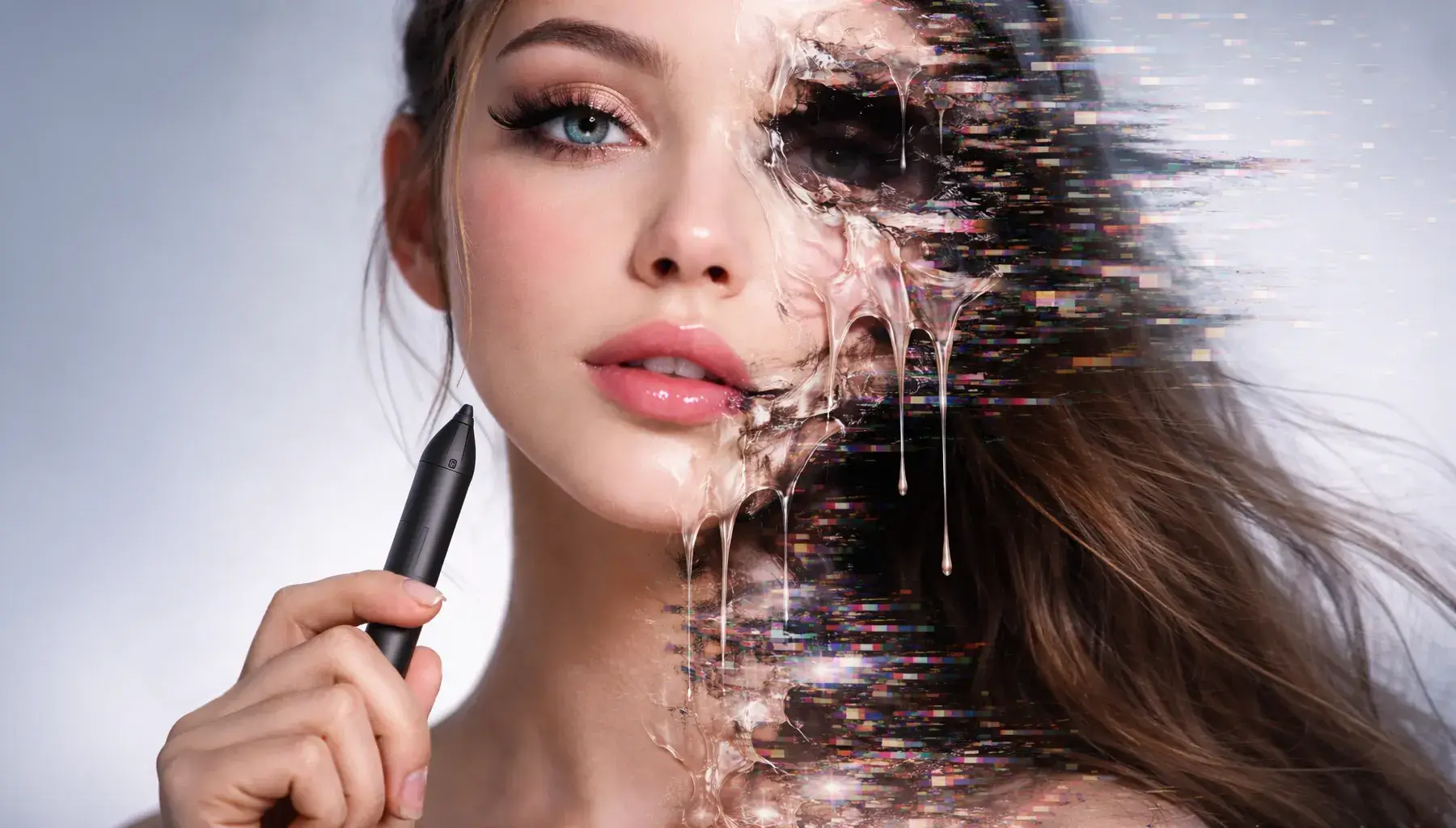
Coming from my mobile office, I walk through the wet streets of Berlin and stop in front of a large-format billboard. A perfected model face stares back at me — radiant beauty, empty gaze. AI-generated. No photographer composed that shot. No retoucher spent hours refining the skin. A computer built this person from nothing, and she has no feelings, no character, no story behind the lens.
Three years ago, images like these were photographed and retouched by hand. Retouching was part of my job. Now it has lost most of its relevance. An entire branch of the profession — quietly disappearing?
The debate around AI vs manual retouching tends to focus on speed and cost. But the real shift goes much deeper. To understand it, you have to know what came before.
“A computer built this person from nothing, and she has no feelings, no character, no story behind the lens.”
When a USB stick meant a week of work
There was a time when the photographer had done their part — perfect lighting, flawless composition, every product angle nailed — and then handed me a USB stick full of raw files. I would load hundreds of images into Lightroom or Capture One, grade each one with a colour look, adjust tonality, brightness, and contrast. And then the real work began.
“I went into every single image and manually removed distracting elements, optimised backgrounds, altered reflections, smoothed metal surfaces, wiped dust from chrome,” says Rüdiger Lauktien, founder of Lauktien Studio. “I changed surfaces until they looked hyperrealistic. That took hours. Sometimes I spent several days on a single image — and the post-production alone could cost thousands.”
That was 2022. Before Generative Fill. Before Firefly. Before the entire retouching industry shifted beneath our feet.

Lauktien.Studio handles AI-Visuals professionally for you and gets your results from 80% to a 100%.
What AI changed in the Photoshop retouching workflow
When Adobe introduced Generative Fill in Photoshop in 2023, powered by its Firefly image model, the conversation around retouching changed overnight. Tasks that once required a steady hand and the patience of a watchmaker — removing objects, extending backgrounds, replacing elements — suddenly became a matter of selecting an area and typing a prompt. By 2024, Adobe rolled out the Firefly Image 3 model, bringing noticeably better photographic quality and a more intuitive understanding of complex prompts directly into Photoshop.
The Remove Tool, now backed by AI, can wipe distracting elements — people, cables, dust, reflections — with a single click. The Harmonise feature, introduced in beta in 2025, blends composited elements into their surroundings so convincingly that what used to take hours of manual colour matching now happens automatically. And by late 2025, Adobe even opened Generative Fill to third-party models like Google’s Gemini and Black Forest Labs’ FLUX, giving retouchers a choice of AI engines inside a single tool.
For brands and agencies commissioning product imagery, the implications are enormous. Turnaround times have collapsed. Costs have dropped. And the gap between a “good enough” edit and a polished, professional result has narrowed dramatically.

AI vs manual retouching — what it really means for the retoucher
But there is another side to this story — one that rarely makes it into Adobe’s press releases.
“The first thing that changed is simply that many photographers don’t go to a retoucher any more,” Lauktien explains. “With all these AI tools, photographers can now work so autonomously that they no longer depend on an external digital retoucher.”
The numbers confirm what practitioners have been feeling. A 2024 survey by Retouching Academy found that over 45% of retouching freelancers reported a decline in workload over the past two years. Research published by the Brookings Institution showed that freelancers in AI-exposed occupations experienced a 5% drop in earnings after the release of new generative AI tools.
“You can see it across the industry — the revenue for purely manual retouching projects is shrinking,” Lauktien observes. “Only the jobs that need real expertise still land on a retoucher’s desk. Everything else, photographers handle themselves now.”
Even on those remaining projects, the dynamic has shifted. “With a bit of skill and patience, you can now achieve very good results through a mix of traditional handwork and AI tools,” he adds. “The retoucher’s value is no longer in the hours — it’s in the judgement.”
This is the uncomfortable truth behind the efficiency headlines. Generative AI didn’t just make creative retouching faster — it redistributed who does it. The photographer who once handed over a memory card now finishes the job themselves. The junior retoucher who learned the craft by cloning out blemishes for eight hours a day? That role is evaporating.
Check out our super old school Photoshop Retouching Projects.
Where AI still fails — and craft still matters
And yet, for all its speed, generative AI has blind spots. Lauktien points to a vivid example: the key visual for the Friedrichstadt-Palast Grand Show “Blinded by Delight” — a project featured in his portfolio.
“The hands of the character couldn’t be generated realistically enough with Midjourney,” he recalls. “So we ended up retouching the hands from the real photo shoot into the AI image to make it look convincing.”
That was early 2025 — and AI-generated anatomy is improving fast. But the underlying point stands: on high-stakes key visuals, there is almost always a gap between what generative tools deliver and what the final image requires. Today it might be hands; tomorrow it could be a tricky fabric texture or an unusual lighting scenario. The projects that still arrive at a specialist’s desk are the ones where someone needs to close that last gap — and closing it demands the kind of judgement you only build through years of manual work.

The future of the retoucher — adapt or disappear
So does the classic retoucher have a future? Lauktien is clear-eyed about it.
“There will always need to be someone who makes the decisions. And it will become an increasingly rare asset to actually have the hands-on skill to solve special cases,” he says. “But the trend is clearly towards fewer purely operative jobs. I’d think very carefully about whether I really wanted to become a retoucher today.”
He has watched colleagues dig in. “I know some who fight tooth and nail against AI, trying to protect and justify their profession. But that fight seems like wasted energy to me. Things will change disruptively — whether we want them to or not. Only those flexible enough to adapt will survive.”
“I know some who fight tooth and nail against AI, trying to protect and justify their profession. But that fight seems like wasted energy to me.”
For brands and agencies, this is worth paying attention to. The retouching partner you need in 2026 is not the one who can clone-stamp faster. It is the one who understands both the craft and the technology — who knows when to let AI do the heavy lifting and when to step in with twenty years of muscle memory.

Better results, and a little bit of longing
Asked how all of this feels on a personal level, Lauktien doesn’t hesitate.
“It’s fun that tasks which used to drive me crazy can now be done more easily. And the results are consistently better — which excites me, because that’s the added value I want to offer my clients.”
Then he pauses.
“But I also miss the good old days when we built a photo scene in the living room with a bedsheet and a bedside lamp to photograph a light bulb — and turned that into a Photoshop composite. That was real craft.”
“We built a photo scene in the living room with a bedsheet and a bedside lamp to photograph a light bulb — and turned that into a Photoshop composite.”
It is a feeling many creative professionals will recognise. The tools got better. The work got faster. And something intangible — the late nights, the stubborn pixel-pushing, the pride of solving an impossible edit by hand — quietly slipped away.
The question for brands is no longer AI vs manual retouching — it is both, together. The question is whether you want someone steering the result who remembers what it felt like to build the scene with a bedsheet — because that instinct for craft is exactly what makes AI output exceptional instead of merely acceptable.
Lauktien Studio combines traditional retouching expertise with AI-driven workflows to deliver photorealistic product imagery and creative compositing for brands and agencies.
Rüdiger Lauktien
Married to his wonderful wife, father of two. Drummer, dreamer, pipe-smoker, photographer, adventurer and a man of faith. More than 15 years of experience in the creative industry. Awarded Digital Artist and Art Director.