Key visual briefing template: how to brief a key visual agency in 2026
How to brief a key visual agency: the email that decides round one or round five
Every key visual project lives or dies on the same email. It is the brief — a one-pager, two-pager, sometimes a hastily forwarded thread — that the producer sends to the studio on a Friday afternoon. Knowing how to brief a key visual agency starts there. From those lines, the agency reads campaign, audience, mood, deliverables and deadline. Then they decide which artists to put on the job. Furthermore, a tight brief means round one comes back close to target and round two ships. In contrast, a loose brief means five rounds, three escalations and a rebuild on Sunday. Ultimately, the difference is rarely talent. Above all, it is the brief itself.
So this article is the structure we hand to brand teams and agency producers who ask us how to brief a key visual agency without burning weeks on misalignment. It is not a generic creative brief. That distinction matters. A campaign key visual carries a different load than a project-management deliverable. It has to read at billboard scale, hold up across OOH and social, survive translation into ten markets, and still feel like the brand. Consequently, the brief needs different fields than a Notion template can give you. Below is what we actually use.
“The brief is half the campaign. We can tell within twenty seconds whether round two will ship — or whether we are negotiating a treatment for a month.”
Senior CGI art director, Lauktien Studio
This piece is, in effect, that twenty-second test written down — and turned into a key visual briefing template that brands can copy straight into their kick-off doc.
How to brief a key visual agency: why it is not a generic creative brief
Most creative-brief templates online were written for project teams shipping landing pages and social posts. For instance, the AMA creative brief toolkit is a fair example. In practice, they cover objective, audience, deliverables and tone. However, they treat the visual as an output, not as the centre of gravity. In a campaign key visual, the image is the strategy. Moreover, every word of the brief either pushes the visual closer to the idea or quietly pulls it away. As a result, a brief that works for a webinar page rarely survives contact with a hero render.
The key visual briefing template below adds four fields that generic briefs leave out. Visual hierarchy on the surface. Production mix (CGI, AI, photo, hybrid). Surface map — where the image will actually appear. And the non-negotiable brand rules. In addition, it cuts out the fields that quietly waste time. Long brand-history paragraphs. Taglines the agency cannot influence. Bullet lists of vague adjectives. To go deeper, see our pillar on campaign key visuals, which anchors how we read briefs in the first place.
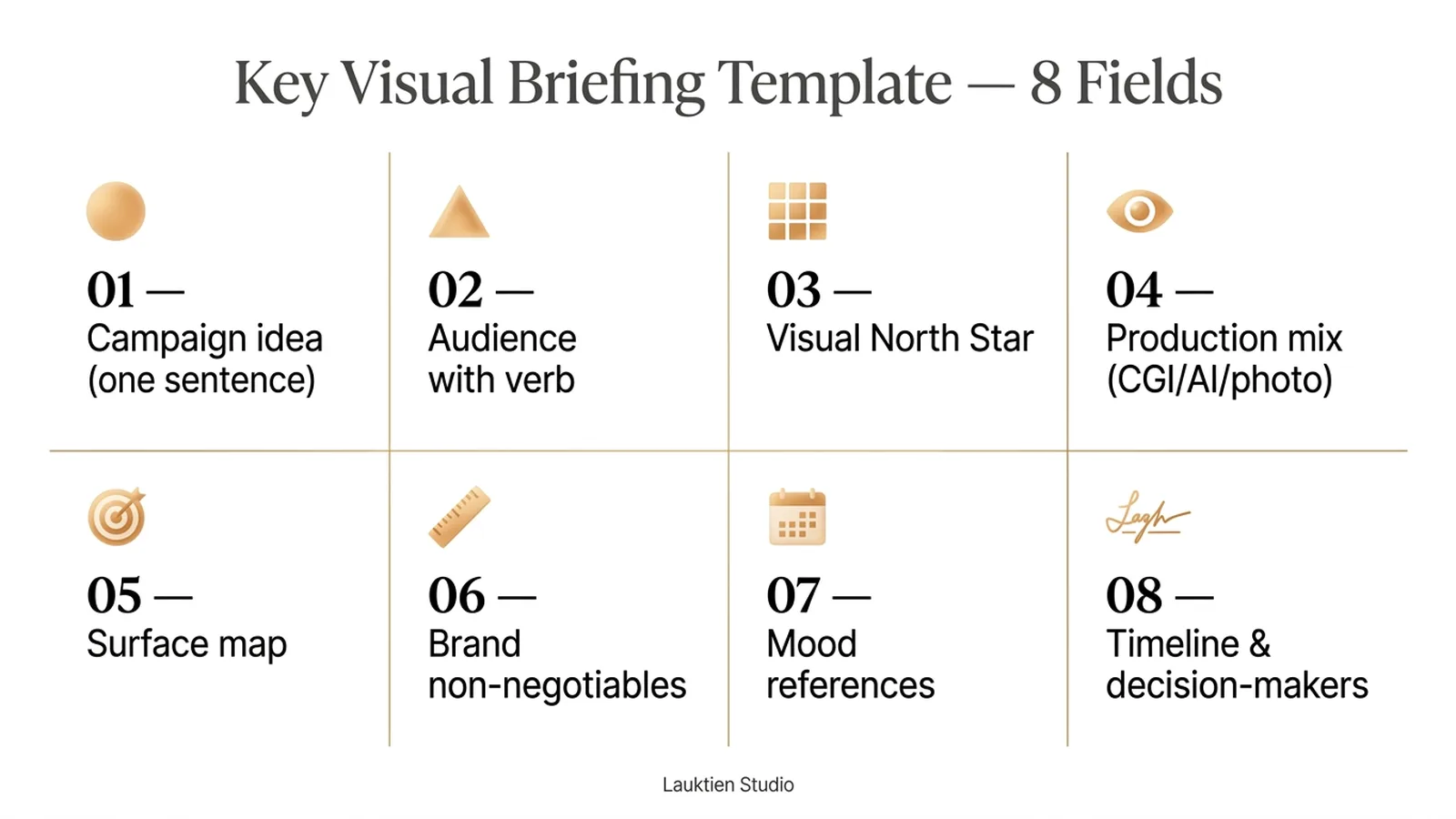
The eight fields of a key visual briefing template that actually works
1 — The campaign idea, in one sentence
Not the slogan. Not the tagline. Not the deck title. Instead, one sentence that tells the studio what the campaign is fundamentally about. Above all, what the audience should feel and what they should do. If you cannot write it in one sentence, the brief is not ready. Furthermore, the studio will write it for you in their first call. In other words, you might as well do it yourself and stay in control of the framing.
2 — The audience for the key visual, with a verb attached
“Premium urban consumers, 25–45” is a slide. “We want a Berlin-based commuter to stop scrolling on their phone for half a second” is a brief. The verb is what tells the agency where to direct the visual energy. Consequently, every micro-decision in the render — eye line, motion, light direction — has somewhere to land.
3 — The single hero idea (the “Visual North Star”)
This is the field most generic briefs miss. It is a one-line description of the image you are trying to build, even if you do not know what it looks like yet. Examples: “the perfume bottle becomes a piece of liquid architecture”, or “the SUV emerges from a single sheet of light”. As a result, the agency has a north star to test every option against — including their own.
4 — The production mix (CGI, AI, photo or hybrid)
Will this key visual be CGI, AI-generated, photographed or hybrid? In 2026, the answer is almost always hybrid. Nevertheless, the brief should indicate what you have in mind. Moreover, naming the mix early lets the studio assign the right artists from day one. Otherwise, you reshuffle after round two. In addition, we unpacked the trade-offs in our piece on AI vs CGI for advertising. Consequently, producers often forward it straight back into a brief as the rationale paragraph.
5 — The surface map: where the key visual will actually live
List every surface the visual will adapt to. For example: 6×3 OOH, 4×5 Instagram, 16×9 YouTube pre-roll, 1×1 Amazon main, A4 trade ad, retail end-cap, internal brand book, sales deck. Furthermore, note which surface is the master — the one from which the others derive. Without this step, the studio composes for the deck. Then at round three, you discover the master should have been a portrait OOH all along.
6 — Brand non-negotiables
Three to five hard rules — for example, typography use, logo clear-space, colour palette codes, packaging accuracy, regulatory text and model casting if applicable. In contrast, leave the negotiables out of this section. If something is “preferred but flexible”, say so. Otherwise, the agency treats all rules as equal. Consequently, you waste a round protecting a typeface nobody cared about.
7 — Mood references in your key visual brief
Six to ten reference images is the sweet spot. In contrast, fewer, and the studio guesses too much; more, and the references contradict each other. Above all, annotate each reference with one short sentence. Specifically, tell us what you like about it. For instance, “we love this image” is not a reference, but “we love how the light leaves the bottle on this image” is.
8 — Timeline, budget band and named decision-makers
Three things here. First, a realistic timeline with named milestones. Secondly, a budget band rather than a single number. Finally, the names of the people who can say “approved”. Most importantly, named decision-makers prevent the round-three surprise. You know the one — a director nobody mentioned wants the whole composition reversed. As a side benefit, naming them keeps the producer from being squeezed in the middle.
What a great key visual briefing template feels like to read
A good brief reads like a film treatment, not a spreadsheet. It is short — two pages, sometimes three when references are inline. Almost every sentence forces a creative decision rather than describing one. Consequently, when the studio finishes reading, they should be able to sketch the first thumbnail without picking up the phone. In our experience, briefs that pass this test halve the number of rounds. They also lower the production stress on both sides. We saw exactly this on our recent full-CGI Dior key visual. The brief was tight enough that round one only needed colour and crop tweaks.

How to brief a key visual agency: mistakes that quietly cost a round
First of all, ambiguity disguised as freedom. “Surprise us” is not a brief. Instead, it is a dare, and dares cost rounds. Secondly, contradicting references. For instance, one image shows hard chiaroscuro, another flat soft light, with no note about which direction matters. Furthermore, late-stage stakeholders. If the global CMO will see the work in round two, the global CMO needs to see the brief in round zero. In addition, deliverable creep — adding a square crop “while you are at it” after the master is locked. Finally, the unspoken brand rule. Nobody wrote it down, but everyone polices it in review.
“Half the brief is what you decide to leave out. The other half is naming the people who will say no — before they say it.”
European campaign producer, anonymised
Every one of these mistakes is fixable on the briefing side, before a single render starts. As a result, two careful hours on the brief save two anxious weeks on the production. We applied the same discipline to product CGI in our piece on how to brief a CGI studio, which is the natural sister read for anyone briefing image-led work in 2026.
The agency angle: what we hope every brief to a key visual agency contains
From the studio side, the briefs we love share three quiet qualities. First of all, they tell us what the visual is fighting against. For example: a competitor campaign, a category cliché, a previous shoot that did not work. Secondly, they tell us what success looks like beyond a single image. In addition, they explain how the look extends to social, retail and sales decks. Above all, they trust the studio with the “how” while staying clear on the “what” and the “why”. As a result, the work feels collaborative from the first sketch.
The studios that ship great key visuals consistently are not the ones with the loudest reels. They are the ones who get briefs like this and treat them with care. Furthermore, the brands that ship great key visuals are not the ones with the largest budgets. They are the ones who write briefs that respect the craft on the other side of the email.
Let’s brief your next key visual agency project together
If you have a campaign on the runway and an agency hunt looming, send us the brief at any stage. We will tell you what we would still ask for, in writing, before we quote. No pressure, no pitch — just a working pass on whether the brief is shippable as is. Or whether two more lines would save the production. Get in touch with Lauktien Studio →
Lauktien Studio is a Berlin-based CGI and creative retouching studio working with international brands and agencies on campaign key visuals, 3D product visualization, AI-assisted commercial imagery and creative retouching.

Rüdiger Lauktien
Married to his wonderful wife, father of two. Drummer, dreamer, pipe-smoker, photographer, adventurer and a man of faith. More than 15 years of experience in the creative industry. Awarded Digital Artist and Art Director.