A field guide for brands and agencies choosing between speed and certainty
It is Friday afternoon. The brief lands: a hero visual for the Q3 launch, due Monday. A transparent flacon on a wet ceramic surface, soft late-afternoon light, no human in frame. Someone on the call says, “let’s just AI it.” Someone else says, “no, we need CGI for that.” Both of them are partly right. Both of them are partly wrong. Welcome to the AI vs CGI advertising debate of 2026.
This is the AI vs CGI advertising conversation happening in agencies and brand teams every week now. And the honest answer is almost never “pick one.” The studios shipping the strongest work in 2026 are the ones who know which tool earns its place on which job — and how to combine the two without compromising the brand. Below is the field guide we use at the studio when a client briefs something and asks us, with that very particular tone, “could we maybe just do this with AI?”
What AI image generators are actually good at
Let us start where AI is genuinely strong, because pretending otherwise would be daft. For mood boards, concept iteration and early-stage exploration, AI is now indispensable. You can sketch out fifty visual directions before lunch. In minutes, a creative director sees a flavour, a tone, a vibe — without booking a studio, hiring a stylist or burning a retouching day. Pre-testing layouts, atmospheres and lighting moods that would have cost three days and a weekly budget two years ago.
Moreover, AI wins for backgrounds, atmospheric extensions and ambient elements where pixel-level fidelity simply does not matter. A wet alley at dusk behind your foreground hero. Maybe a blurred cityscape outside a car window. Or just a hint of foliage. Your audience will never zoom in on these. Brand-safe, generic-enough environments are exactly what diffusion models do best.
On top of that, AI is fast. Truly, ridiculously fast. For social-first campaigns where the cost of being late outweighs the cost of being slightly imperfect, that speed is a real strategic advantage. If you want a deeper look at where this fits into a broader visual strategy, our overview of commercial AI key visuals for brands and agencies walks through the decision points in detail.
Where CGI still wins (and is not going anywhere)
However, there is the other half. The stuff most agencies are quietly relieved about.
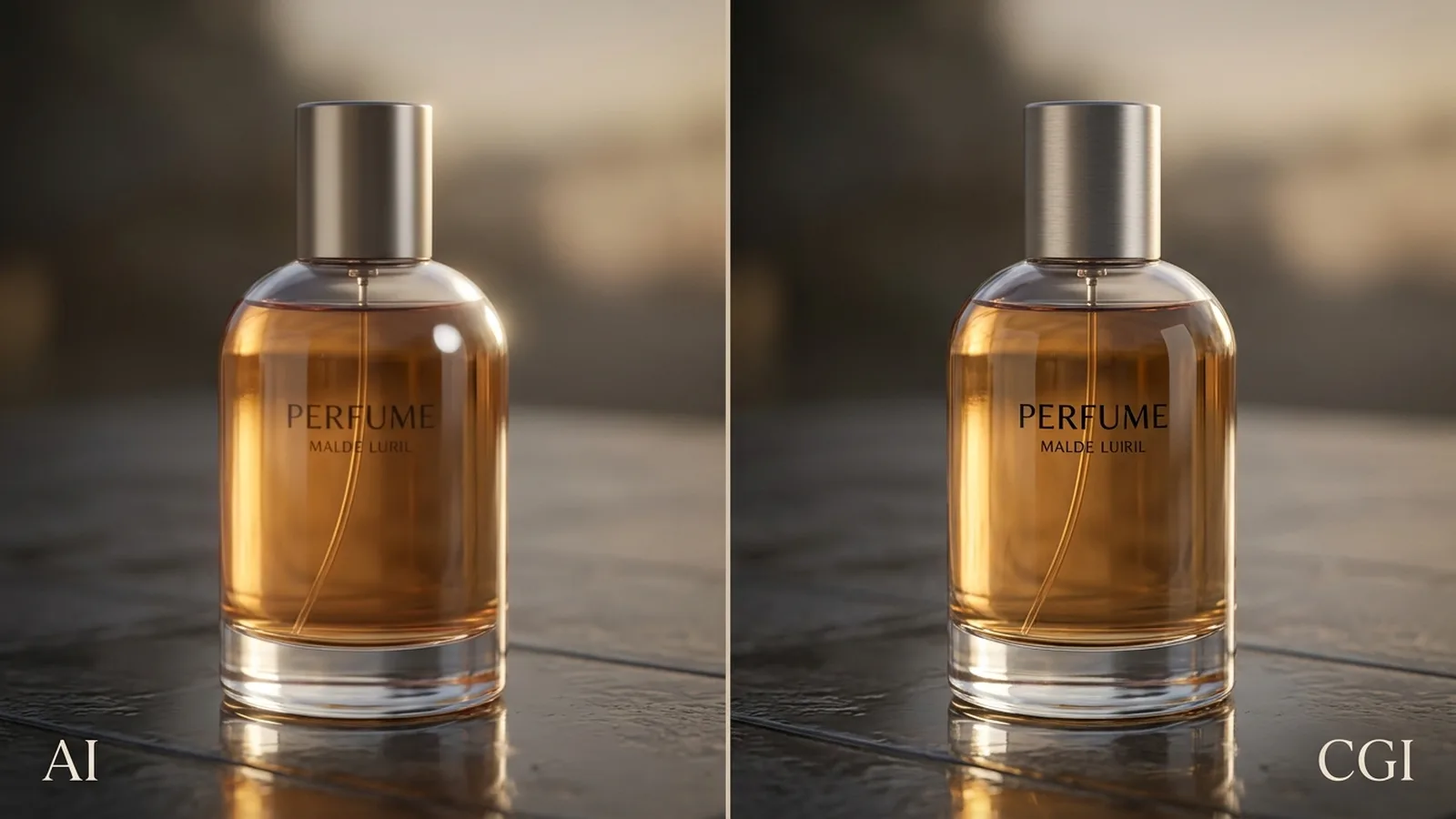
As soon as your visual has to be exact — the actual product, the actual label, the actual surface finish, the actual proportions — AI starts losing. Not because the models are not impressive. They are. But because they do not know what your bottle looks like. The typography has a specific descender on the lowercase ‘g’ — the model does not care. The metal cap is anodised, not chrome — the model does not notice. Instead, it guesses. Plausibly. Beautifully, sometimes. But they guess.
The moment your visual has to be exact — AI starts losing.
In contrast, CGI does not guess. A 3D model is a digital twin of your real product, built from your CAD data, your material specs and your label artwork. Light it any way you want. Spin it. Replace the lid. Show it in five colourways before lunch. Every frame is consistent, every detail is correct, every variant is on-brand. This is the entire premise of 3D product visualization for brands and agencies — and it is why beverage, cosmetics, automotive and tech clients keep coming back to the technique.
Furthermore, CGI wins on rights and reuse. Your renders are yours. Forever. No model release issues, no usage windows, no licensing complications around training data. You build a campaign in March, refresh it in November, drop a German variant in February — and you are not negotiating with anyone.
Above all, there is craft. The thing AI struggles to replicate is not realism. It is intention. A skilled CGI artist places every reflection, every speck of dust, every refractive distortion because they decided it should be there. That is the difference between a generated image that happens to look nice and a designed image that carries a brand voice.

The hybrid playbook: combining AI vs CGI advertising strengths
In reality, this is the part nobody puts on a pitch deck. The smartest creative teams in 2026 are not picking between AI and CGI. They are combining them, scene by scene, layer by layer.
Consequently, the hero product is always CGI. The product is the entire reason the campaign exists.
Meanwhile, the environment around it is often AI. Wet pavement, blurred neon, a sweeping mountain road, an abstract studio gradient that would have cost a real cyclorama and three days of retouching. Generated in minutes.
The post-production layer that makes the two feel like a single image? That is creative retouching for brands and agencies. Matching colour, matching grain, building light continuity, integrating shadows, removing the giveaways that would otherwise make the seam visible. As a result, without that final pass, hybrid work falls apart on a six-metre billboard. With it, nobody can tell.
This is what most AI vs CGI advertising work actually looks like in 2026 once you peel the layers back. Not pure AI. Not pure CGI. A workflow.
How to choose: AI vs CGI advertising decision framework
In practice, when a brief lands on the desk, we run it through three quick questions. You can use the same.
First of all: does the audience need to recognise this as your product specifically? If the answer is yes — packshot, hero shot, anything where the brand asset is named or shown closely — go CGI. The cost of an AI hallucination on your packaging is brand damage, not just an ugly frame.
Secondly: how often will this asset be reused, refreshed or adapted? The more lifetimes a visual will have — multiple markets, multiple sizes, seasonal updates — the more CGI pays for itself. You are not paying per asset, you are paying once for a 3D pipeline that prints variants forever. AI makes one image at a time, and asking it for the “same” image again with one small change is, to put it kindly, a coin flip.
Finally: is anyone going to look closely? Out-of-home posters, premium print, packaging, anything where the audience can stop and squint — CGI. Fast-scrolling social, motion-first formats, ambient brand atmosphere — AI is often enough.
In other words, if the answers are mixed, that is the signal you need a hybrid approach. Most briefs land here.
The legal and brand-trust side of AI imagery
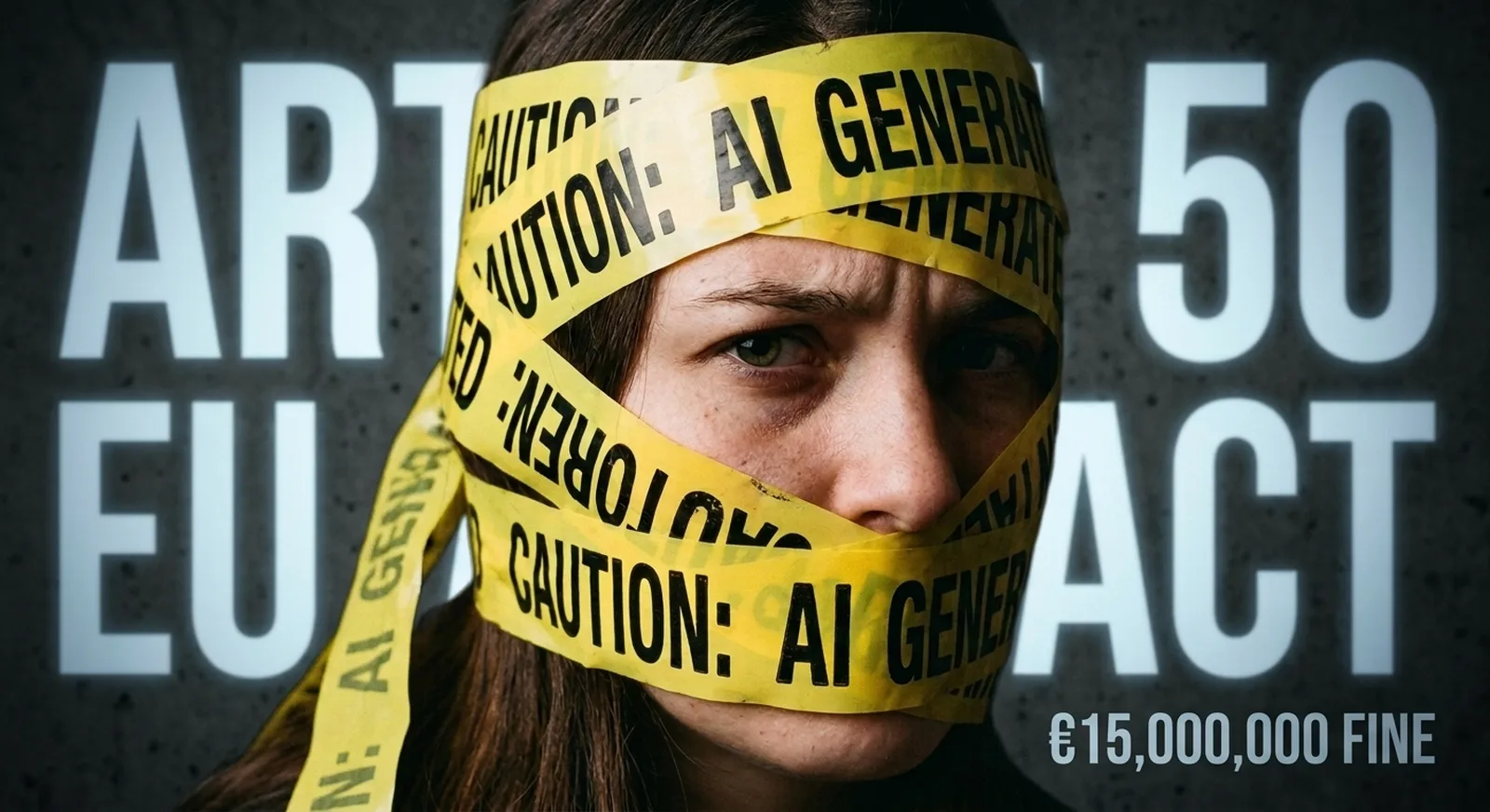
You cannot talk about AI versus CGI in 2026 without addressing the trust question. According to a Getty Images global study of over 30,000 consumers, nearly 90% of consumers want to know whether an image they see has been created with AI. Ninety-eight percent agree that authentic imagery is pivotal in establishing trust in a brand.
In short, that changes everything. Authenticity is no longer a creative-director preference. It is a measurable factor in how your brand is perceived.
Authenticity is no longer a creative-director preference. It is a measurable factor in how your brand is perceived.
The 3D advertising market reflects that preference materially: it was valued at USD 7.7 billion in 2025 and is forecast to almost double by 2034, growing at over 7% annually. Brands are not moving toward CGI because it is nostalgic. They are moving toward it because it is verifiable, ownable and consistent — three things that matter more, not less, in an era flooded with synthetic imagery.
Consequently, for luxury, premium consumer goods, regulated categories and any brand where craft and provenance are part of the proposition, this gap will widen, not close. The AI-only studios will keep producing impressive frames. The brands building lasting equity will keep asking who actually made the image and whether they own it outright.

AI vs CGI: so what is the right answer?
The AI vs CGI advertising question depends on the asset, the audience, the longevity and the level of brand precision required. That is not a cop-out — it is the actual answer.
Ultimately, what matters more than the tool choice is having a partner who can argue both sides and pick the right one for each frame of the campaign. Studios that only do CGI will tell you AI is dangerous. Studios that only do AI will tell you CGI is overkill. Neither is a useful collaborator.
You want the team in the room that can render your product with millimetre accuracy when accuracy matters, generate a believable Tokyo at dusk in twenty minutes when speed matters, and stitch the two together without anyone noticing the seam. That is the work. Everything else is opinions about software.
Let’s talk about your next campaign
If you are staring at a brief and wondering which side of the AI-versus-CGI line it sits on, that is exactly the conversation we have with brands and agencies every week. Sometimes the answer is full CGI. Other times it is an AI-led mood test followed by a precision render. More often than not, it is a hybrid that nobody can spot.
Get a quote for your next project and we will work through the brief with you. If you want to see examples first, the studio portfolio and our other agency-facing insights are good places to start — and the portfolio is full of examples showing the kind of detail CGI delivers that AI still cannot.
Lauktien Studio is a Berlin-based CGI, AI key visual and creative retouching studio working with international brands and agencies on hero campaigns, packshots and product films.

Rüdiger Lauktien
Married to his wonderful wife, father of two. Drummer, dreamer, pipe-smoker, photographer, adventurer and a man of faith. More than 15 years of experience in the creative industry. Awarded Digital Artist and Art Director.