What luxury beauty looks like when nothing on the image was ever in front of a lens
The supplier sample arrives in a small black box. The art director unwraps it, sets it on the desk, and turns it slowly under a desk lamp. The bottle catches the light in exactly the way the brand wanted — warm amber refracting through faceted glass, the cap a cool brushed silver, the foiled label sharp as a pin. Then she takes a photo of it on her phone, sends it to the photographer, and the photographer writes back: “Beautiful. I can shoot it. But not like that.”
That’s the moment cosmetics 3D rendering stops being a curiosity and starts being a budget line. Because what the bottle is, in the room, on the desk, under the lamp, is not what the bottle looks like through a 50mm prime. Ultimately, glass loses contrast under a lens. Foil dulls. Furthermore, the cap reflects the studio ceiling instead of the abstract gradient the brand pictured. And the beauty industry — more than almost any other category — sells the version of a product that exists in a brand’s head, not the version that exists on the desk.
This article is a lookbook. We’ve pulled together a set of cosmetics 3D rendering projects we’ve delivered over the last few seasons — for fragrance, skincare, lipstick, men’s grooming, and motion-led launches — and unpacked, briefly, what the brief looked like and what made CGI the right call. If you’re a brand or agency wondering whether your next beauty visual belongs in a studio with a softbox or in a render farm with a node graph, this should give you something to think about.
“Photography manages the physics. A render solves it.”
Why cosmetics is the hardest category to photograph — and the most satisfying to render
Every cosmetics product is a small physics problem. Glass refracts. Meanwhile, plastic catches edge light differently. Liquid clings to the inside of a bottle. Foil reflects everything around it. Furthermore, cream picks up subsurface scattering. And labels — those tiny, beautifully designed labels — punish the slightest motion blur or focus drift. According to a technical breakdown by 360 Render, glass alone “transmits, refracts, reflects, and sometimes scatters” light all at once, with crystal-style luxury packaging behaving differently from soda-lime glass at the level of refraction angle. In practice, a photographer manages these problems. A render solves them.
However, the harder challenge is rarely the physics. It’s the consistency. A foundation line launches in twelve shades. Meanwhile, a perfume drops in three sizes. Then a men’s grooming brand adds a fourth fragrance to a quarterly campaign and needs the new bottle to sit alongside the existing three with absolutely identical lighting, identical reflections, identical hero angles. Re-shooting that across a year of campaigns is expensive. Building it once in CGI and re-rendering forever is, in our experience, the moment most brands switch over for good. As a result, once they do, they don’t switch back.
The transparency problem: perfume, glass, and the cost of getting it wrong
Fragrance is where most cosmetics 3D rendering jobs start, and where craft separates studios. The bottle has to look heavy — but transparent. Meanwhile, the liquid has to look saturated — but not opaque. Above all, the cap has to read as the exact metal finish the brand specified, not a generic chrome. And the label, often foiled, sometimes embossed, has to feel printed onto a curved surface rather than pasted on top of one.
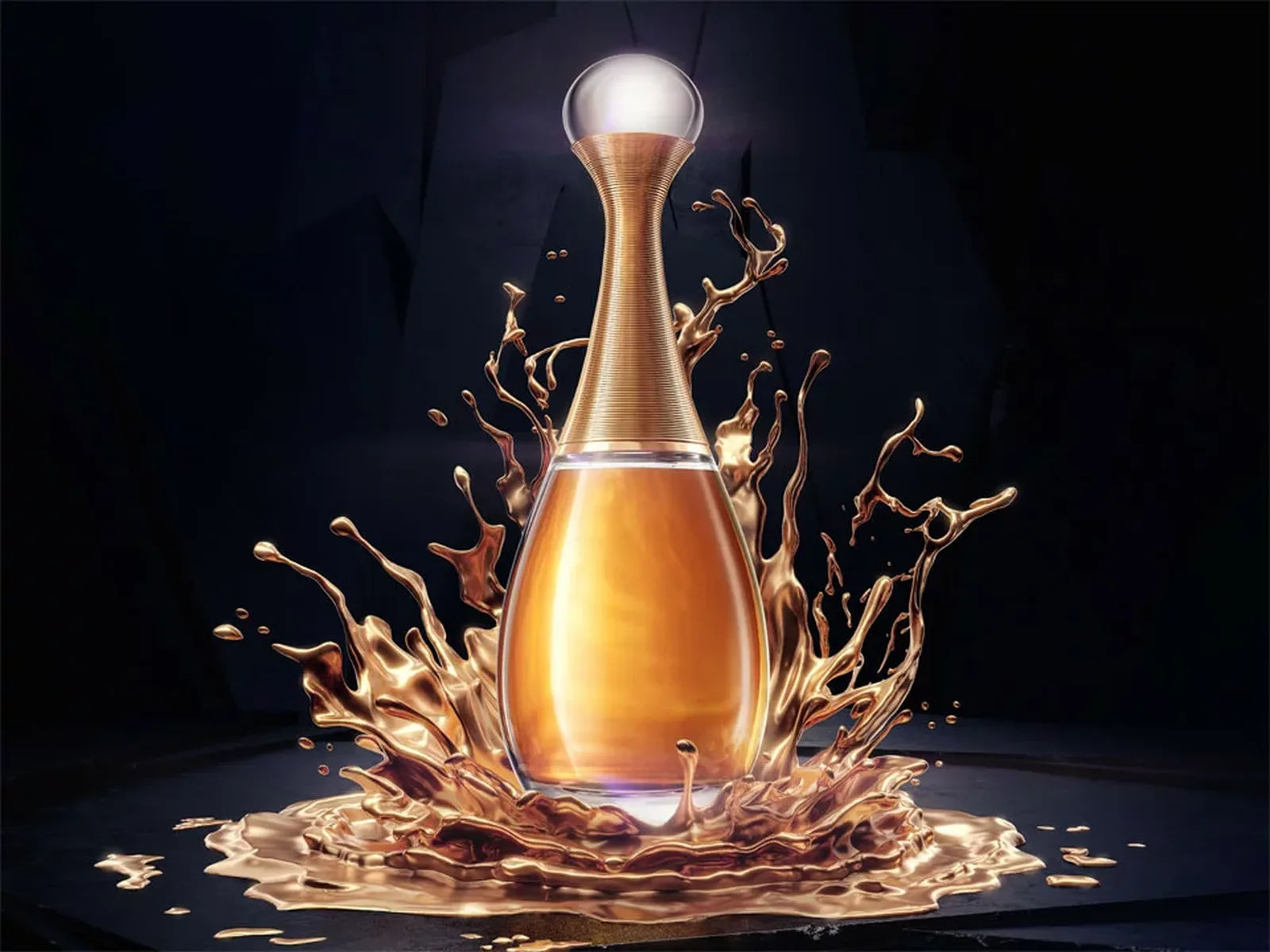
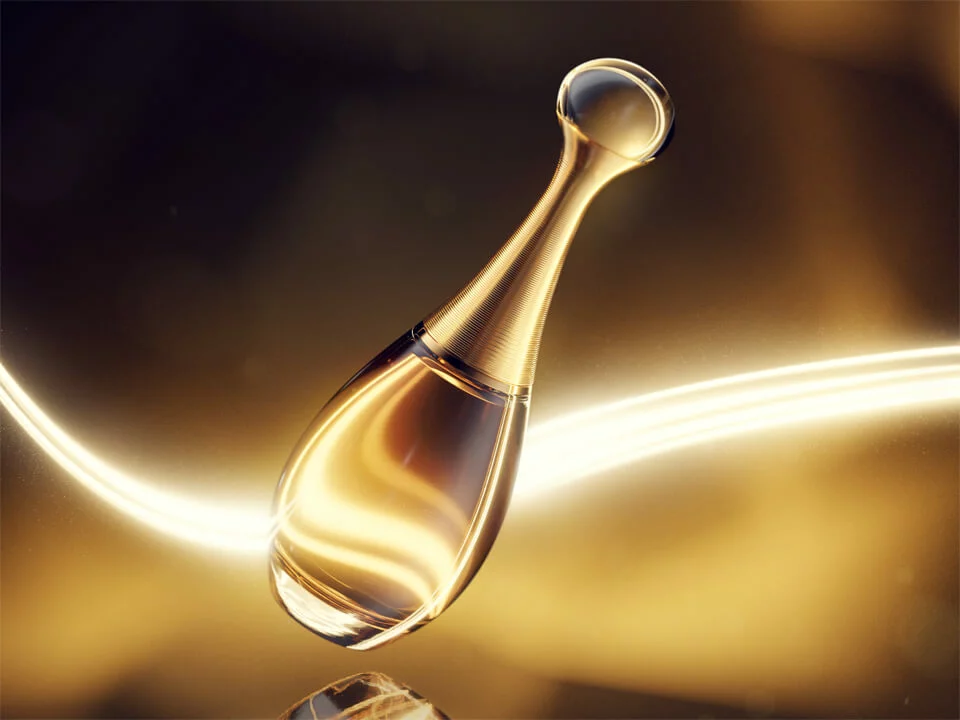
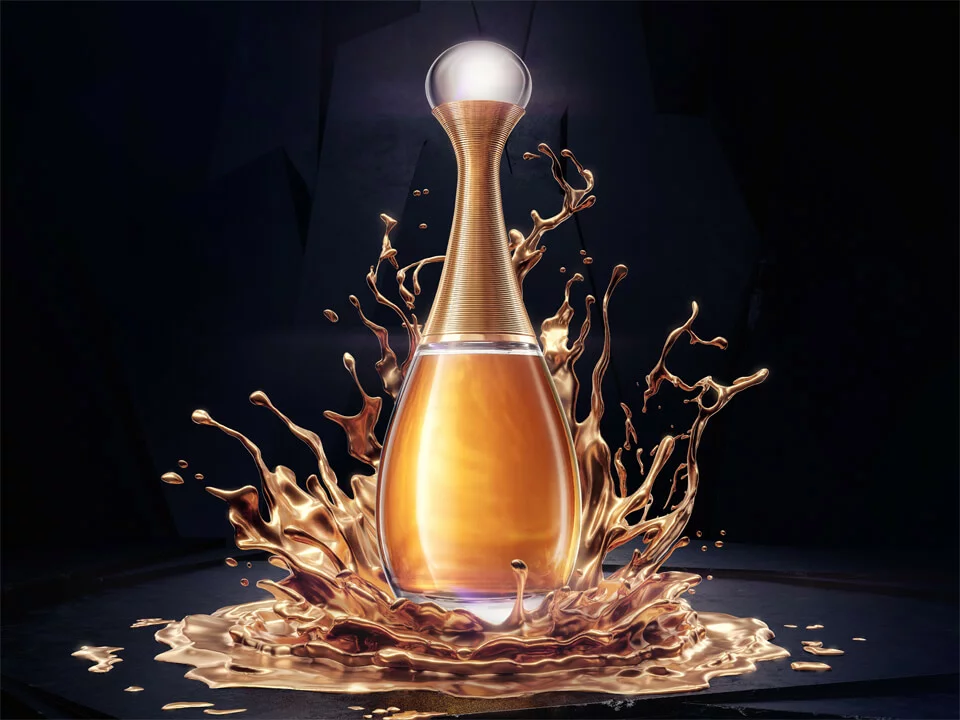
Below is a piece we delivered for a luxury fragrance presentation — a full CGI perfume photography render where every reflection on the glass was sculpted by a custom HDRI we built specifically for the bottle’s facet pattern. No photographer’s softbox would have produced that exact gradient. The brief was a single line: make it feel like the perfume that’s already in the customer’s drawer, two years from now. That’s the kind of brief CGI excels at.
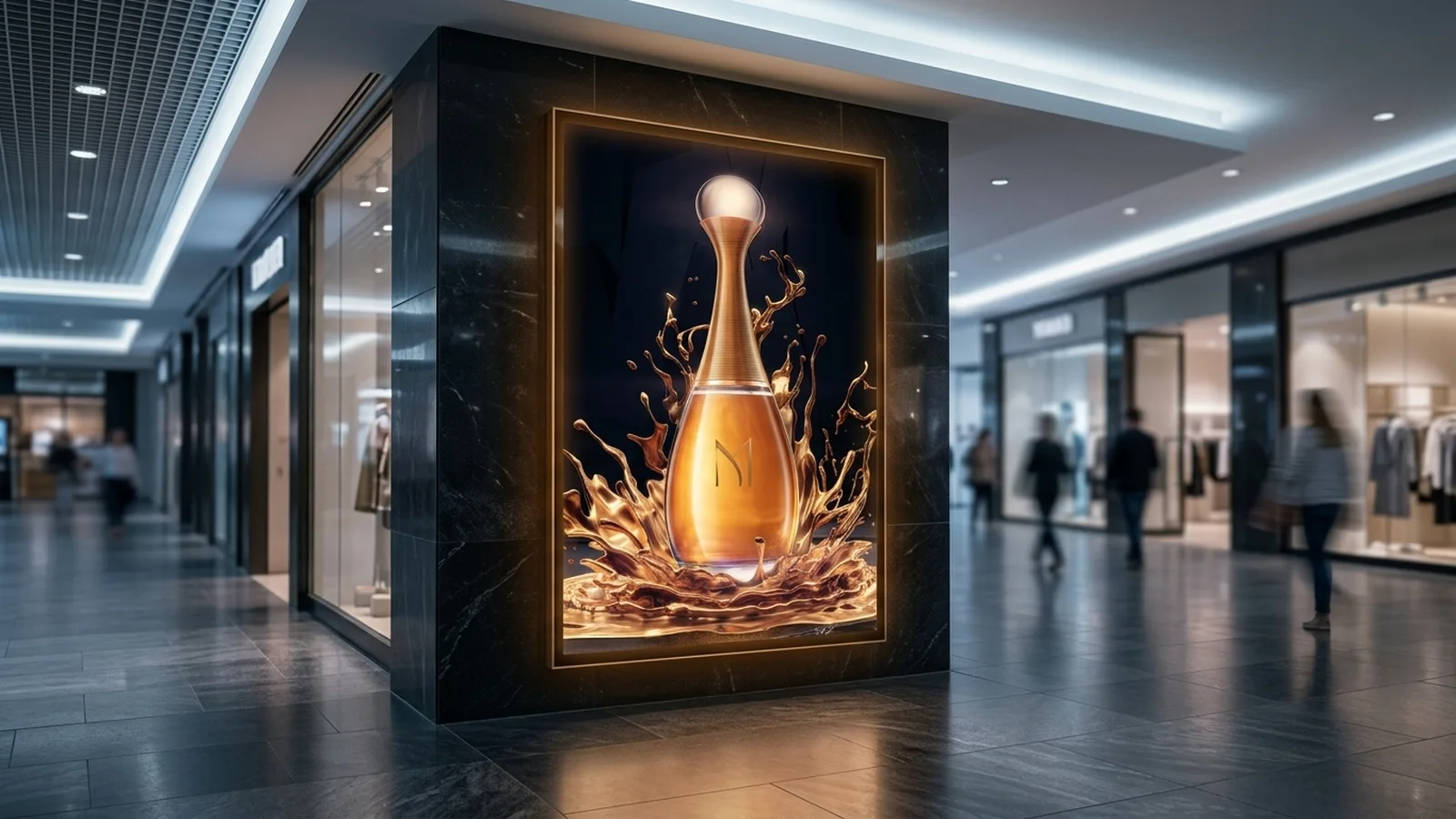
For a slightly different brief — a full key visual rather than a packshot — we built the entire scene including bottle, environment, and atmosphere from scratch. Have a look at the Dior full CGI visual we produced. The brand’s existing photography couldn’t deliver the lighting story they wanted at scale, so we built one. As a result, that same bottle is now ready for any environment, any colour grade, any campaign — without a single re-shoot.
The texture problem: lipstick, cream, and oil under the macro lens
Beauty editorial lives at macro distances. Lipsticks are photographed two inches from the lens. Similarly, creams are pulled apart with a finger and lit from the side. Oil drops form on glass at extreme close-ups where every dust mote becomes visible. In a real shoot, that’s where retouching budgets balloon. In contrast, in a render, those problems vanish — because the dust never existed.
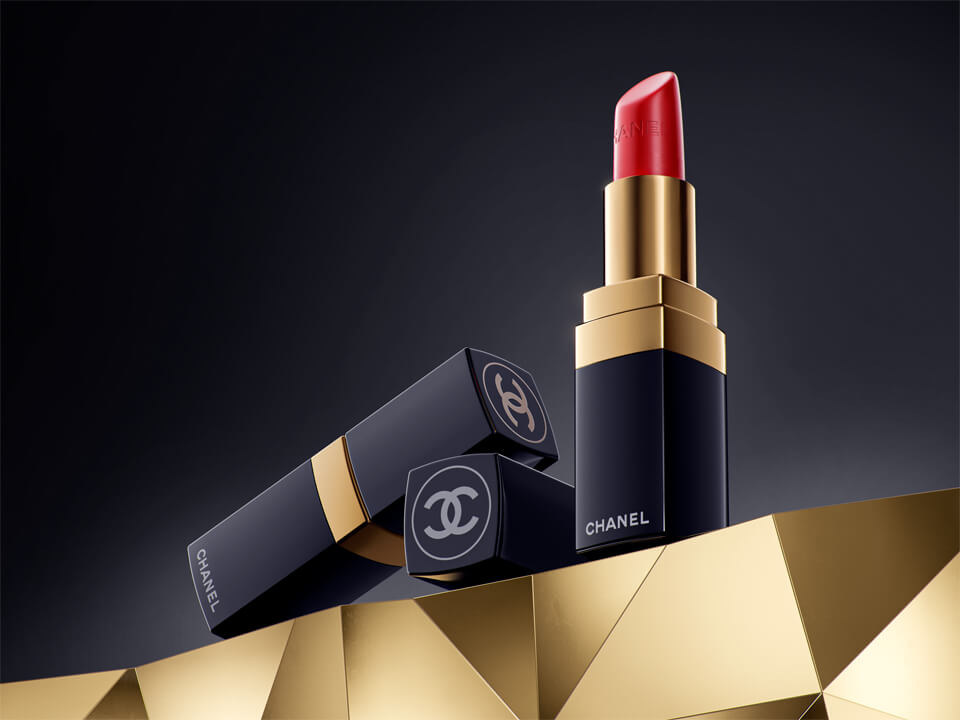
Take a project like our 3D lipstick visualisation. The waxy translucency of the bullet, the precise gradient where pigment density shifts, and the controlled highlight running along the edge of the cap — all of it was built procedurally. Consequently, the next colourway in the line takes a fraction of the time. Same model, different pigment values, ten new SKUs delivered in a day.
Skincare and beauty brings its own challenges — particularly viscous, semi-translucent products and fingertip moments. For a recent squeezed product visual, the entire sequence was shot frame by frame on set as real product photography and then assembled into the final animation. Honestly, that’s often the right call when a physical sample exists, the budget allows a real shoot, and the campaign only needs one hero piece. CGI takes the same brief differently: we’d build the tube, simulate the product’s rheology, and re-render every variant from the same master scene. Both routes work — the choice usually comes down to scale, variants, and whether a physical sample is available at all.

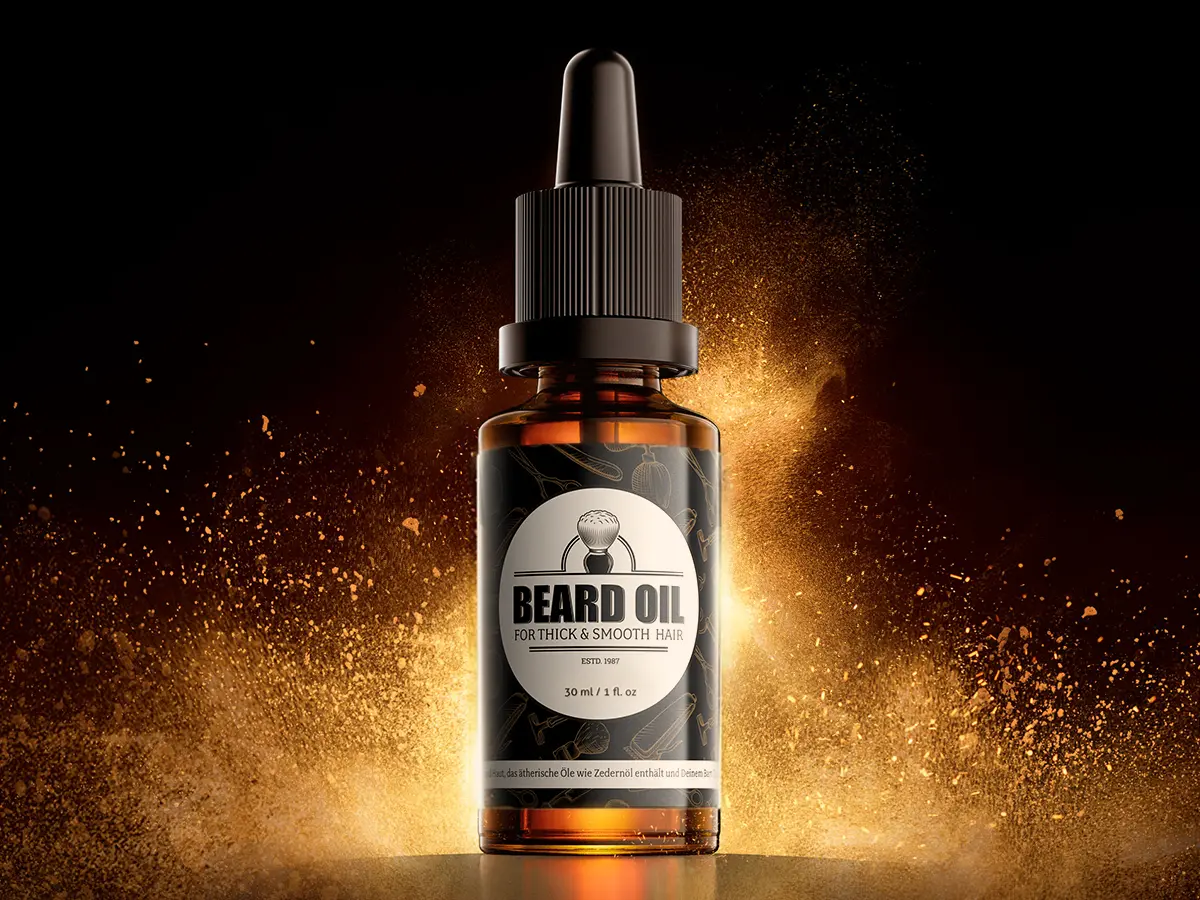
And men’s grooming is a quietly growing CGI category. The product surfaces — matte black plastics, metallic caps, oily liquids — give 3D plenty to work with. Our beard oil CG photography piece pairs a deeply tinted glass body against a satin label and a brushed metal lid. As a result, every component reads as a deliberate material choice rather than an accident of room light.
The motion problem: when a still isn’t enough
Beauty has moved aggressively into motion-first content. Reels, TikTok hero spots, Amazon A+ video tiles, looping web banners — every campaign now ships in twelve aspect ratios, half of them animated. In practice, photography can’t scale to that. Cosmetics 3D rendering can.
Below is an essence Mauve Forward visual we delivered — a hero shot of polish poured over the bottle, captured as real product photography on set. To be transparent: no CGI in this one, just a clean photographic moment of pour. CGI is simply the alternative path when frame-by-frame photography stops being practical: more colourways, more bottle sizes, more aspect ratios than a single shoot can reasonably support. Consequently, the same waterfall can be rebuilt as a fluid simulation and re-timed, re-coloured, and re-shipped overnight whenever the campaign demands it. Both routes export to the same Reels and TikTok formats.

For an even deeper motion play, brands often pair a single hero render with a 360° spin for product detail pages. We’ve covered that workflow separately in our 360° product rendering service — but the relevant point here is that 360° spins of cosmetics packaging convert. Customers want to see the back of the bottle, the bottom of the jar, the precise way the cap closes. CGI is the only practical way to deliver that consistently across hundreds of SKUs.
The variant problem: 14 shades, one model, zero reshoots
This is the part of the cosmetics 3D rendering pitch that closes most agency conversations. A foundation campaign needs every shade represented at hero quality. Similarly, a lipstick line drops with sixteen colourways and three finishes. Then a perfume launch ships in three concentrations and four bottle sizes. Photography multiplies linearly with variants — every SKU is its own shoot, its own retouch, its own approval cycle.
CGI doesn’t. Once the master scene is built — bottle geometry, label artwork, lighting rig, camera setup — every variant becomes a parameter change. New shade? Simply update the pigment value. New label artwork? Drop in the artwork file. New finish? Toggle the material from glossy to matte. Then the render farm does the rest overnight. As a result, the marginal cost of variant 16 is roughly the same as the marginal cost of variant 2. Ultimately, that’s the calculation that puts CGI into the planning meeting before the brief is written.
“Build the master scene once. Render every variant forever.”
The industry signal: where cosmetics CGI is heading in 2026
It isn’t only the studios pushing this shift. The brands themselves are building internal pipelines. Cosmetics Business reported that L’Oréal partnered with the 3D AI studio Omi to build photoreal product visuals at scale across its brand portfolio, citing faster launches and lower production cost. Estée Lauder, LVMH, and Chanel have all expanded their internal CGI capabilities in parallel. Meanwhile, the broader 3D rendering market is forecast to grow from $6.32 billion in 2026 to $28.04 billion by 2035, with marketing and advertising taking roughly a quarter of that share.
In other words, this isn’t a fringe technique anymore. It’s becoming the default production pipeline for premium beauty — and the brands not yet on it are increasingly the ones at risk of looking inconsistent next to competitors who are.
“The brands not yet on CGI aren’t behind on a trend. They’re slowly looking inconsistent next to the brands that are.”
When cosmetics 3D rendering isn’t the right call
Honestly, not every beauty visual belongs in CGI. Editorial human photography — a model with the product in hand, real skin, real expression, real campaign casting — still belongs to a photographer. Likewise, authentic in-context lifestyle: someone applying a cream in a real bathroom, someone uncapping a perfume on a real café terrace. CGI can simulate those moments, but the cost-benefit usually flips against it.
Where CGI consistently wins is product-first content: hero packshots, e-commerce stills, Amazon listing imagery, motion launches, packaging variant scaling, and any campaign that needs ten visuals from one master scene. We covered the broader trade-off in our CGI vs product photography piece — worth reading if your team is mid-decision. And if your project sits in a hybrid zone — packshot in CGI, model shoot in studio — the post-production seam is usually our creative retouching service, which is built precisely to invisibly join the two.
How to brief a cosmetics 3D rendering project so it actually works
Ultimately, the shortest path to a great cosmetics CGI render is the same path as any 3D project: a clean brief. Send the bottle’s CAD or technical drawings, send the artwork as vector, send a physical sample if one exists, and above all, send a reference image for every material in the brief — not a description of it. We’ve written this up in detail in how to brief a CGI studio, which is worth fifteen minutes if you’re starting your first project.
The single best move you can make as a brand or agency is to call early — before the brief is signed off, before the campaign timeline is locked, before the budget gets divided between studio days and post-production. CGI changes the shape of the project. Building it into the plan from the start is always cheaper than retrofitting it once the photographer has already booked the studio.
Let’s talk about your next beauty visual
If you’re a brand or agency working on a fragrance launch, a skincare line, a colour-cosmetics drop, or a campaign that needs to scale across formats — we’d love to see what you’re planning. Cosmetics 3D rendering is one of the categories where the difference between a good studio and the right studio shows up in every reflection on every cap. Send us the brief, even if it’s still rough. We’ll tell you what’s straightforward, what’s tricky, and what we’d build differently.
Browse more of our work in our portfolio, dig deeper into the service on our 3D product visualisation page, and reach out whenever you’re ready.
Lauktien Studio is a Berlin-based CGI and creative studio specialising in cosmetics 3D rendering, 3D product visualisation, 360° product animation, and creative retouching for brands and agencies.

Rüdiger Lauktien
Married to his wonderful wife, father of two. Drummer, dreamer, pipe-smoker, photographer, adventurer and a man of faith. More than 15 years of experience in the creative industry. Awarded Digital Artist and Art Director.